Losing Yourself in Motherhood: Finding the Way Back
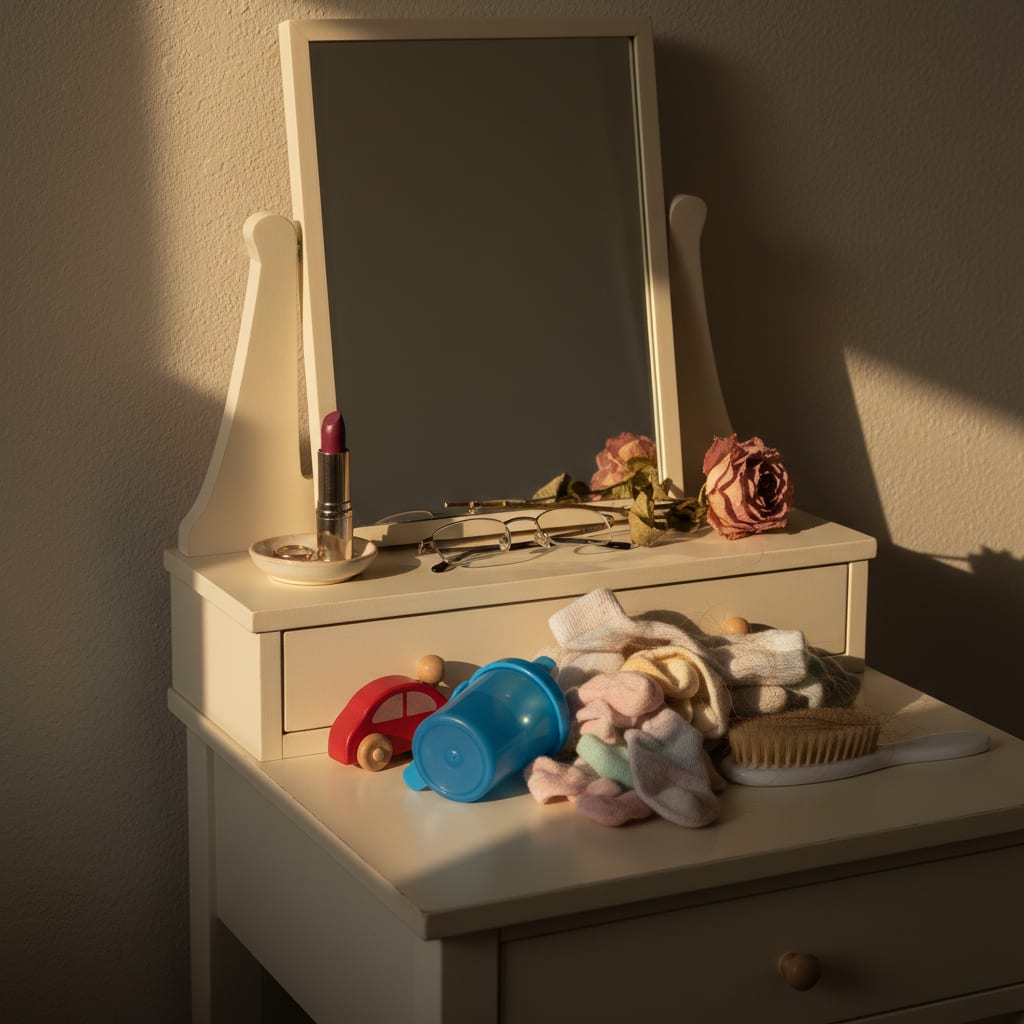
Losing yourself in motherhood is grief, not malfunction. Something real went missing — the woman whose name was on things, who had opinions she’d defend, who owned an hour that belonged to nobody else. Mourning her is the correct response, not a symptom, and the way back is rarely a reinvention; it’s the slow reclaiming of small specific pieces. The one distinction worth holding is between grief and something heavier. Grief still wants: it aches toward what it lost. If the wanting itself has gone quiet for weeks, that’s a different conversation, and it belongs with a professional.
Why this question is so hard to look up
Type the phrase into a search bar and see what comes back: therapy practices, almost exclusively. Clinician blogs with numbered lists of causes, symptom taxonomies, a contact form at the bottom. I don’t say that to be snide — those are real practitioners doing real work, and I’ll be sending you toward one myself before this piece is over. But it means the first thing a woman meets, at 10pm, googling a feeling, is a page that treats the feeling as a condition with six causes and an intake process.
Most of the time it isn’t a condition. It’s what happens when a person spends four years being interrupted. You are allowed to read about it without being assessed.
What the disappearing actually feels like
It is almost never dramatic. Nobody loses herself on a Tuesday in a single identifiable event. It goes like this instead:
Someone asks what you’ve been up to and you hear yourself answer entirely in other people’s news — his job, the four-year-old’s swimming, the two-year-old’s ear infection — and you notice, halfway through, that you have supplied no information about yourself because there wasn’t any to supply.
You get an unexpected free hour and spend fifty minutes of it trying to remember what you like.
You have an opinion about something in the news, and it arrives strangely soft, unrehearsed, because you haven’t had to defend a position out loud since you stopped having colleagues.
You dress for the day and realize the deciding factor was washability.
None of that is failure. It’s the arithmetic of a job with no boundaries: everything expands to fill the woman available. The pieces that go first are the ones nobody else notices are missing, which is exactly why the loss stays private and why it takes so long to name.
There’s guilt attached to naming it, too — the sense that missing yourself is an insult to your children. It isn’t, and if it helps to hear it in other women’s words rather than mine, the phrasing in this collection of lines about mom guilt does the job better than an argument does. Two things stay true at once: you’d choose them again, and you miss her. That’s the whole shape of it. Our piece on loving your kids and hating the job sits on the same fault line.
Grief, or something heavier
Here is the line I’d want a friend to know, and the reason this piece signposts help instead of diagnosing.
Grief is loud and specific. It has an object. You miss something — the work, the competence, the version of you who travelled light. It hurts in a way that still points at what you want. That kind of ache is workable, and the rest of this piece is about working it.
Something heavier tends to be flat rather than sharp. The wanting goes quiet. Good moments land behind glass. Rest doesn’t touch it, weeks pass without the weather changing, and a running narrator insists that this is simply who you are now. That is not the grief of a changed life, and it is not something to out-organize with a hobby.
If any of that sounds like your kitchen, the move is a professional — a common, unremarkable, effective move. Postpartum Support International: 1-800-944-4773 (call or text) helps mothers well beyond the first year and can route you to local care. If you’re in crisis or having thoughts of harming yourself, call or text 988 now. Our longer walk through that distinction is burned out, or something more — same signposting, more room.
The way back is smaller than the internet suggests
The advice industry answers this question with a rediscovery narrative: find your passion, take the trip, remember who you were. It flatters, and it fails, because the woman you’re grieving had resources you don’t currently have — chiefly uninterrupted time, and she isn’t getting it back this year.
What works is narrower and less romantic.
Reclaim a preference, not a passion. Passions need hours; preferences need seconds. The coffee you actually like. The radio station that isn’t for the kids. Choose four things a week purely on your own taste and the muscle starts to come back — because losing yourself is mostly the atrophy of preferring.
Keep one thing that has nothing to do with anyone in this house. One. A book club, a language app, a Wednesday swim. Its content matters far less than the fact that no one else has a stake in it.
Have one real argument. Not with your husband — about something. Politics, a novel, whether the film was any good. Holding a position out loud against someone who disagrees is remarkably restorative, and it is the specific thing that vanishes when you stop having colleagues.
Say the thing you’re not saying. Most women in this season have never once told another adult “I miss myself.” Say it to a friend, to a partner, into a notes app at 11pm. Unsaid, it curdles into the flat, general sense that something is wrong with you.
Expect it to feel disproportionate. Twenty minutes of something that’s yours will produce a return wildly out of scale with twenty minutes. That’s not a trick — it’s evidence about how starved the preferring muscle got.
The sameness of the days makes all of this harder to see from inside, which is its own subject: the groundhog-day years are the terrain this grief happens on.
One small thing this week: make four decisions on your own taste alone — the coffee, the music, the walking route, what you eat when nobody’s watching. Not self-care. Practice at preferring.
FAQ: losing yourself in motherhood
Is losing yourself in motherhood normal?
Extremely — and it’s the predictable consequence of a role with no edges rather than evidence of a weak sense of self. The parts of you that go first are the ones only you would miss, which is why it’s so common and so rarely mentioned out loud.
How do I know if it’s identity loss or depression?
You often can’t tell from the inside, and you don’t have to. The rough pattern: grief still wants things and points at what it lost; the heavier thing goes flat and quiet, ignores rest, and lasts for weeks regardless of circumstances. Bring the pattern to your doctor or to PSI (1-800-944-4773) and let them make the call.
Can you find yourself again while your kids are still small?
Yes, but in smaller pieces than the phrase implies. Full reconstruction usually waits for time you don’t currently have; preferences, opinions and one protected thing are available now, and they’re what the reconstruction is later built from.
Does wanting my old self back mean I regret having kids?
No. Missing a previous life is not a verdict on the current one — you can be certain about your children and still mourn the woman who could leave the house on ten minutes’ notice. Both things staying true is the defining arithmetic of this whole season.
Three Good Reads

Spending Money You Didn't Earn (The Feelings Part)
Why spending money you didn't earn feels strange as a stay-at-home mom — the guilt, the asking, the worth question — and how to put the flinch down for good.
July 27, 2026

Keeping Long-Distance Friendships Alive on Naptime Hours
How to keep long-distance friendships alive as a stay-at-home mom — naptime-sized rituals that hold real closeness when visits and long calls can't.
July 23, 2026
Is Being a Stay-at-Home Mom Worth It? Asking Mid-Tantrum
Is being a stay-at-home mom worth it? An honest accounting of both columns, why mid-tantrum is the worst moment to run the numbers, and how to answer it.
August 7, 2026