Babies Napping Outside in the Cold: Is the Nordic Habit Safe?
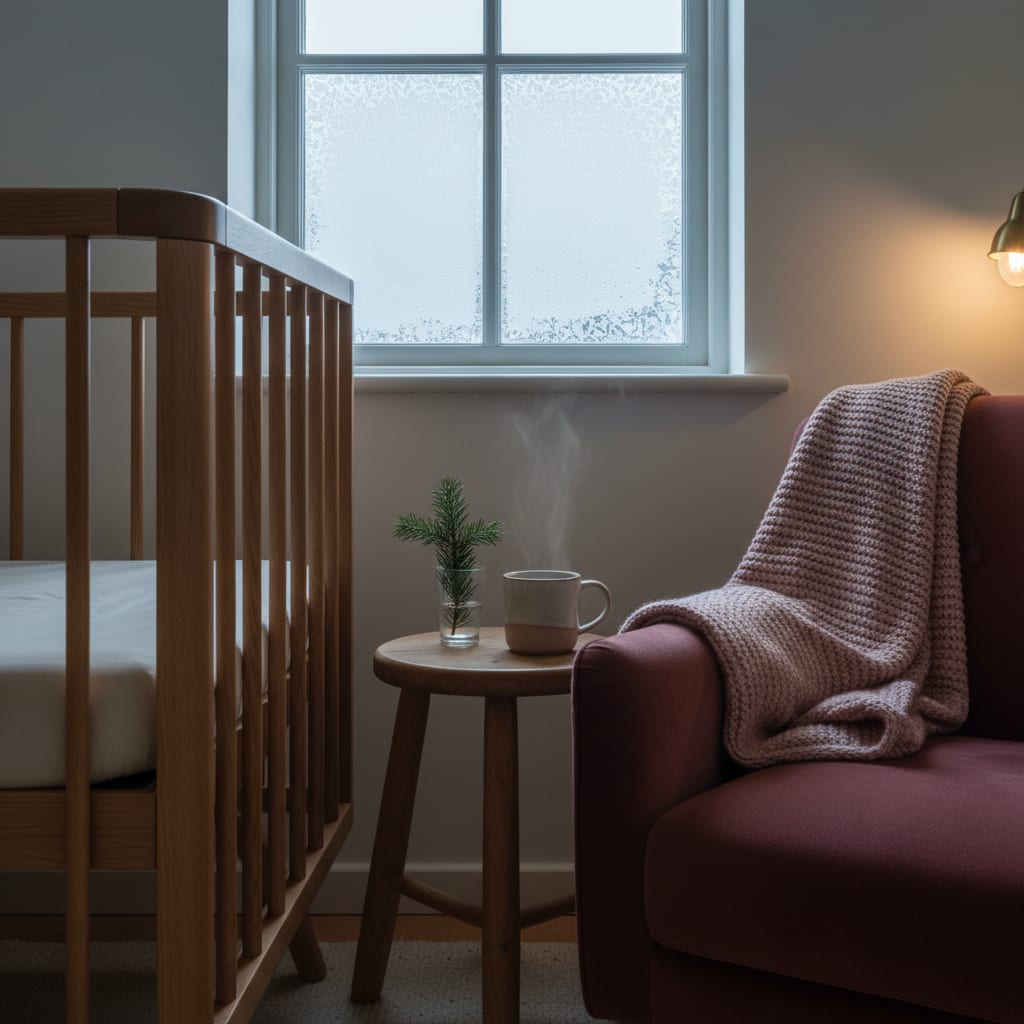
In Finland and other northern countries, putting a bundled baby down for a daytime nap outdoors in a pram, even below freezing, is ordinary, and the small Finnish studies of it found longer naps outside. But those studies measured skin temperature and nap length, not safety, and US guidance does not endorse it: NIH’s Safe to Sleep program says strollers are not a regular sleep or nap space. The fair reading is a real cultural norm with real risks (cold, overheating in layers, loose bedding, an unwatched child) that does not transfer neatly to an American backyard.
Why the picture is so tempting
Everyone has seen the photos: prams parked outside a café in the snow, babies asleep inside, parents warm behind the glass. If you are home all day with a baby who naps for 35 minutes and wakes furious, the picture isn’t really about fresh air. It’s about a long nap and an hour that belongs to you.
That wanting is worth noticing, because it is the same feeling that makes comparing yourself to other moms so corrosive. One curated image of somebody else’s system can make your careful, ordinary choices look timid. They usually aren’t.
What the Nordic practice actually is
The best-documented version is Finnish. A 2011 paper by Marjo Tourula and colleagues in the European Journal of Applied Physiology describes it plainly: “It is a common practice in Northern countries that children aged about 2 weeks to 2 years take their daytime sleep outdoors in prams in winter.”
An earlier survey by the same group (International Journal of Circumpolar Health, 2008) asked 116 parents of under-twos in the city of Oulu about it. Parents described it as common and “taken for granted.” It usually began when the baby was about two weeks old, happened once a day, and took place in outdoor temperatures from -27°C to +5°C, roughly -17°F to 41°F.
Mothers interviewed in a 2013 study (Journal of Transcultural Nursing) linked it to family well-being “when all security perspectives were first taken into account.” That clause matters. The practice lives inside a culture’s knowledge about clothing, prams and weather; it is not a hack you lift out of it.
What the research found, and what it didn’t
The finding everyone quotes is the nap. In a 2010 Acta Paediatrica study of three-month-olds, 34 outdoor and 33 indoor naps at home, sleep time was “92 min longer” outdoors than indoors.
Less often quoted: skin temperatures fell during outdoor naps, faster the colder it was, “in spite of increased clothing,” and on some occasions the researchers saw cold extremities. Outdoor naps got shorter as cooling sped up. The authors suggest bulky clothing restricting movement probably helps the long naps, which is less romantic than fresh air.
In the 2011 paper, clothing did not track the temperature at all. Babies were dressed about right near -5°C (23°F), overdressed when it was warmer and under-insulated when it was colder. The authors’ own conclusion was that “the necessity for guidelines is obvious.”
And the 2008 parent survey shows both risks at once. Parents reported cold fingers in 3% of children sleeping at 0°C and 25% at -15°C. “Almost half of the children had sweaty necks at 0 degree C,” the abstract adds. The researchers called for objective measurements “before guidelines for allowing children to sleep outdoors in the winter can be updated.”
So, honestly: these are small Finnish observational studies of skin temperature and nap length. They were not designed to show the practice is safe, and they don’t measure illness or sleep-related deaths. “Babies sleep longer outside” is in them. “Babies are healthier for it” is not.
What US safe-sleep guidance says
The NIH’s Safe to Sleep program says: “Car seats, strollers, and sitting devices are not recommended as baby’s regular sleep or nap space. If baby falls asleep in a sitting or carrying device, move them to their regular sleep space as soon as possible.” The AAP’s HealthyChildren site agrees: move them “to a firm sleep surface on their back as soon as possible.”
It names strollers as a category and offers no cold-weather exception. Three other parts of it collide with the pram nap:
- Bedding. A blanket or duvet tucked around a sleeping baby conflicts with HealthyChildren’s cold-weather page, which says loose bedding “should be kept out of an infant’s sleeping environment” and recommends wearable blankets instead.
- Overheating. Bundling for cold is how a baby gets too hot, and the AAP says overheating “can increase the risk of SIDS.” Its check is sweating, a hot chest or flushed skin: hence the Finnish sweaty necks at 0°C.
- The cold itself. HealthyChildren notes that children lose heat faster than adults, and that hypothermia can start with shivering and move to sluggishness or clumsiness. It is an emergency: call 911.
Then there’s the part no study measured: who is watching. A baby who has wriggled down under a cover or slumped forward can’t call for you.
And air: AirNow, the federal air-quality site, says that above an AQI of 100 air is unhealthy, “at first for certain sensitive groups of people, then for everyone.” Check it before a long outdoor stretch.
 Longer naps, no snowsuit required
Betteroo builds a personalized sleep plan around your baby's age, so the long nap you're hoping for can happen in the crib.
Take the free sleep quiz →
What you can borrow without the risk
The good part of the Nordic habit is the outdoors. Keep that, and bring the sleep inside.
Take the walk awake, and bring the nap home. A cold-morning walk before the nap does the pram’s work. If the baby drops off on the way, that’s fine. Stay with them, walk home and move them to the crib, as the guidance says.
Dress for the outing, then undress for the nap. Outdoors, HealthyChildren’s rule of thumb for older babies and young children is one more layer than an adult would wear. Indoors, the snowsuit comes off, the hat comes off (the AAP says no hats indoors after the hospital), and a wearable blanket like the HALO SleepSack does the job a pram duvet can’t do safely. Betteroo’s guide to checking warmth at the chest and the back of the neck is useful here, because hands and feet are a poor guide.
Get yourself outside. Some of what the café photo promises is really for the parent: a change of air, a reason to leave the house. Cabin fever is as much the mother’s as the child’s.
Grieve the 92 minutes, then let them go. The fantasy was about a long, guaranteed break. If you need one, get it honestly, through a partner, a sitter or a protected rest block. And if the naps you do get keep going to the laundry, the case for lying down when the baby sleeps is worth rereading.
For the Scandinavian case for outdoor time in every season, Linda Åkeson McGurk’s There’s No Such Thing as Bad Weather makes it warmly. Read it for the walks.
Studies are cited from their published abstracts, read through Europe PMC on 2026-10-31 (PMIDs 18767347, 20377534, 20949360 and 23341404). Guidance quotes are from NIH Safe to Sleep, HealthyChildren and AirNow pages read the same day. Anything about your own baby’s sleep or health belongs with their pediatrician.
One small thing this week: pick a cold-morning walk time before the first nap, and plan the transfer. The fresh air is the part to keep. The crib is where the nap goes.
FAQ: babies napping outside in the cold
Is it safe for babies to nap outside in the cold?
US guidance doesn’t support it: NIH says strollers aren’t a regular nap space, and the AAP flags loose bedding and overheating. Finnish studies found longer naps but did not measure safety.
Why do Scandinavian parents let babies nap outside?
It’s a cultural norm, especially in Finland, where parents surveyed described it as common and “taken for granted,” and reported longer naps.
What temperature do Finnish babies nap outside in?
In a 2008 survey of parents in Oulu, between -27°C and +5°C (about -17°F to 41°F). Babies’ skin cooled faster the colder it was, despite extra clothing.
What if my baby falls asleep in the stroller on a winter walk?
Stay with them, head home, take off the snowsuit and hat, and move them to their crib on their back as soon as you can, as the AAP and NIH advise. A wearable blanket keeps them warm without loose bedding.
Three Good Reads
When the Family Pet Dies: The First Two Weeks of Nights
A pet's death is often a child's first bereavement, and bedtime is where it lands. The empty basket, the guilt at 8pm, and the grief nobody sends a card for.
September 3, 2026
Scripts for Making the First Move (Mom Edition)
Word-for-word scripts for making mom friends — the park opener, the number ask, the first text, the reschedule after a cancel, and how to go deeper.
July 19, 2026
Every Day Feels the Same: The Groundhog Day Years
When every day feels the same as a stay-at-home mom: why the sameness gets to you, what it is actually costing, and how to put one variable back in a week.
August 3, 2026