Family Movie Night Past Bedtime: Worth the Late Finish?
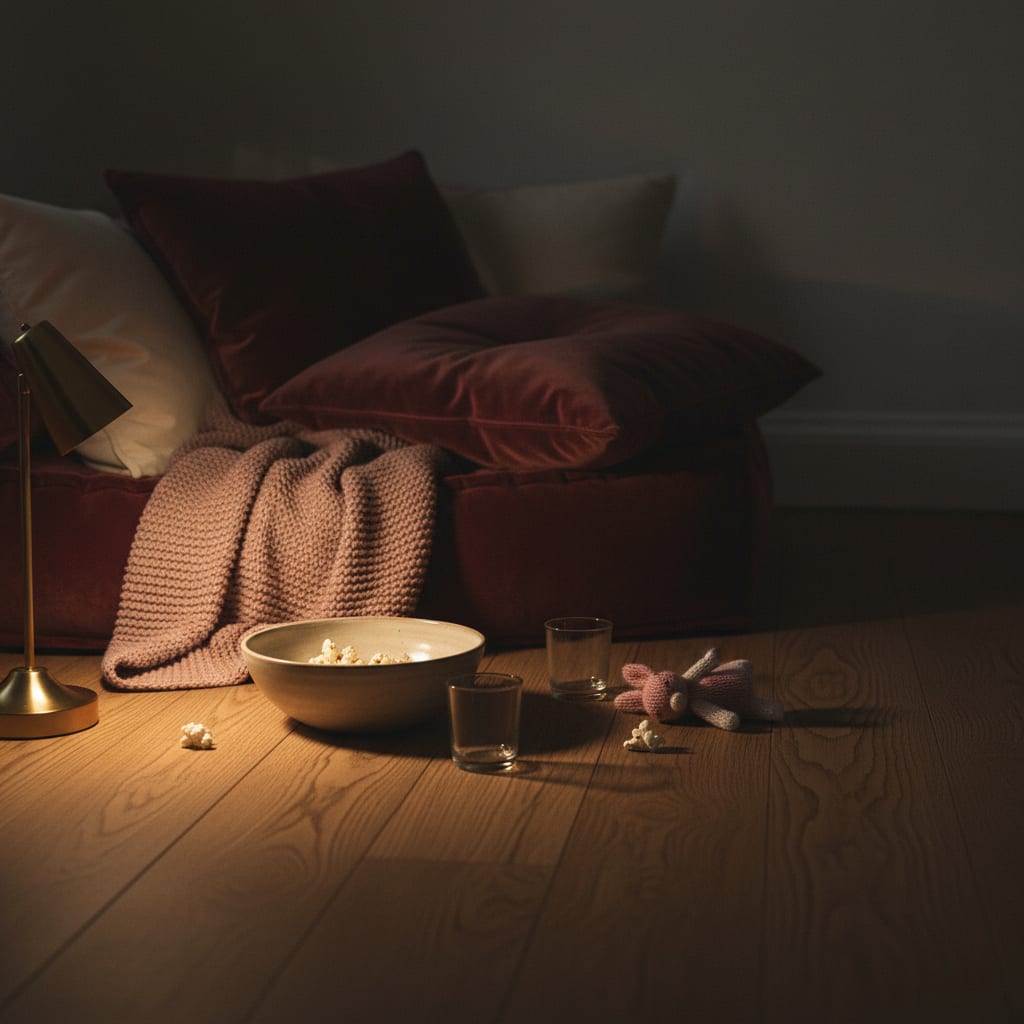
An occasional family movie night that ends past bedtime is usually worth it, and it is not going to ruin anyone’s sleep for good. The cost is real but small and specific: screen light in the last hour pushes back the hormone that makes children sleepy, the credits arrive with no wind-down after them, and the late finish comes out of your evening, not just theirs. Start the film earlier, leave a dull, dim half hour between the credits and bed, hold the next morning’s wake time, and decide before the opening scene that tonight is worth it.
Why movie night is worth protecting
There is a reason this ritual gets so much affection in houses with small children. It is one of the few evening activities that nobody has to run. No craft to supervise, no game to referee, no dinner to cook from scratch. The children are in one place, quiet and warm, and you are allowed to sit down among them and stop being the entertainment.
That matters more than it sounds when you are home all day. For the parent who has been the playground, the snack bar and the referee since breakfast, a Friday film is often the only point in the week where family time and rest happen at the same time. Of course you want to keep it.
And then, at 8:40, the film still has twenty minutes left, the youngest is glassy-eyed and silly, and the evening you were looking forward to starts to feel like a loan you will be paying back until ten.
What the screen light actually does
The official line is simple. The American Academy of Pediatrics’ HealthyChildren site recommends keeping screens out of children’s bedrooms and says to “turn off all screens at least 60 minutes/1 hour before bedtime.” KidsHealth gives preschool parents the same rule: turn off all screens “at least 1 hour before bedtime.”
The reason is light. Researchers at the University of Colorado Boulder had 36 children aged three to five play on a light table in the hour before bed, and reported that their melatonin, the sleep-promoting hormone, was suppressed “anywhere from 70% to 99%” compared with a dim evening. Even in very dim light, “much dimmer than typical room light,” it fell by an average of 78%, and 50 minutes after the light went off, it had not rebounded in more than half of the children.
Two honest caveats. That was a small study, and it used a glowing table at arm’s length rather than a television across the room; the researchers note that a tablet at full brightness, a foot from the eyes in a dark room, measures as much as 100 lux. A living-room TV is a different dose. They also say plainly that the findings don’t mean parents “must throw away the nightlight.” What it does tell you is that young children are more sensitive to evening light than adults, so a film that ends at bedtime is likely to leave them less sleepy than they look.
It’s the late finish more than the film
Light is half of it. The other half is that a movie ends abruptly. One minute everyone is inside a story; the next, the lights are up, the popcorn is in the cushions and someone has to be in pajamas with clean teeth in ten minutes. There is no slope down to sleep, only a cliff.
That is why the meltdown so often happens at the toothbrush rather than during the film. A child who is excited, a bit overtired and full of sugar is being asked to switch off on the spot. If you can’t tell whether yours is running on fumes or simply not tired yet, the 5pm signals are worth knowing, because the two call for opposite fixes.
If the trouble is fright rather than lateness, that’s a different evening. justmotherhood has a good piece on settling a child after a scary movie.
Keeping the night without losing the evening
Move the start, not the film. The simplest fix is an earlier showing. A Saturday matinee at home, or a Friday film that starts straight after an early dinner, gets you the same ritual with a buffer built in. Betteroo’s guide to making movie night feel like an event ends on the same caution: finish with enough time before bed for a calm transition.
Choose for the youngest, and for length. A 90-minute film and a two-hour one are different evenings. Picking for the smallest viewer usually solves both problems at once.
Split it. An intermission is a legitimate parenting tool. Half tonight, half tomorrow, with a cliffhanger thrown in for free, is not cheating anybody.
Make the last half hour dull and dim. When the credits roll, turn off the big overhead light and use the lowest lamp in the house. Skip the bath if it’s late; teeth, toilet, one short book, bed. Anything exciting about bedtime can wait until another night.
Hold the morning. The tempting repair is letting everyone sleep in. HealthyChildren recommends the same waking time “both on weekdays and weekends,” and a much later wake-up tends to push the next bedtime later too. A tired Saturday morning is the cheaper bill.
 Movie night, then actual sleep
Betteroo builds a personalized sleep plan around your child's age, so you know how much room a late night really has before it costs the next day.
Take the free sleep quiz →
Your evening is part of the cost
Here is the part the screen-time advice leaves out. When movie night runs late, the person who pays most is often not the child. It’s the parent who does bedtime, because the late finish eats the only hour of the day that belonged to her.
That’s where the resentment comes from, and it’s information rather than meanness. Loving the ritual and dreading the 9:15 bedtime it produces are both true at once. If your evenings are already thin, protecting the hour after bedtime is worth more than any rule about screens. And if you are always the one doing the late bedtime because you’re the only one the kids will accept, movie night is a good, low-stakes night for your partner to take it instead. The children are already sleepy and happy, which is the easiest version of bedtime there is.
The real trick is deciding in advance. A late night chosen at 6pm, with the morning planned for, feels like a gift. The same night drifted into at 8:45 feels like a defeat. The film is the same; the only difference is whether you chose it.
Quotes here are from HealthyChildren, KidsHealth and the University of Colorado Boulder release on ScienceDaily, read on 2026-10-27. Anything about your own child’s sleep belongs with their pediatrician.
One small thing this week: pick the start time for the next movie night now, and count back from bedtime. If the film doesn’t fit, choose a shorter one, or plan an intermission.
FAQ: family movie night and bedtime
Is it bad for kids to watch a movie right before bed?
Once in a while, it’s fine. As a habit, the AAP recommends turning off all screens at least an hour before bedtime, because evening light and excitement can make it harder for children to fall asleep.
How long before bed should a family movie end?
HealthyChildren and KidsHealth both say at least an hour before bedtime for screens. On a movie night, even a 30-minute dim, quiet stretch after the credits is better than going straight from the screen to bed.
Should we let the kids sleep in after a late movie night?
A little is fine, but HealthyChildren recommends keeping the same wake time on weekdays and weekends. A long lie-in usually pushes the next bedtime later, which makes Sunday night harder.
What if movie night always ends in a meltdown?
Start earlier, pick a shorter film or split it over two nights, and keep the time after the credits dim and dull. If bedtimes are hard on ordinary nights too, it’s worth looking at the routine as a whole.
Three Good Reads

Asking for What You Need (Without a Fight)
How to ask your husband for what you need without it turning into a fight — the timing, the framing, and word-for-word scripts for the asks moms dread most.
July 27, 2026
Baby Waking at 4am: The Early-Riser Fix for Tired Moms
Baby waking at 4am? Why early rising happens, what it quietly does to a mother's mind, and the schedule fixes that move morning back to a humane hour.
July 19, 2026
When the Family Pet Dies: The First Two Weeks of Nights
A pet's death is often a child's first bereavement, and bedtime is where it lands. The empty basket, the guilt at 8pm, and the grief nobody sends a card for.
September 3, 2026