Hamster Wheel Keeping Your Child Awake? What Actually Helps
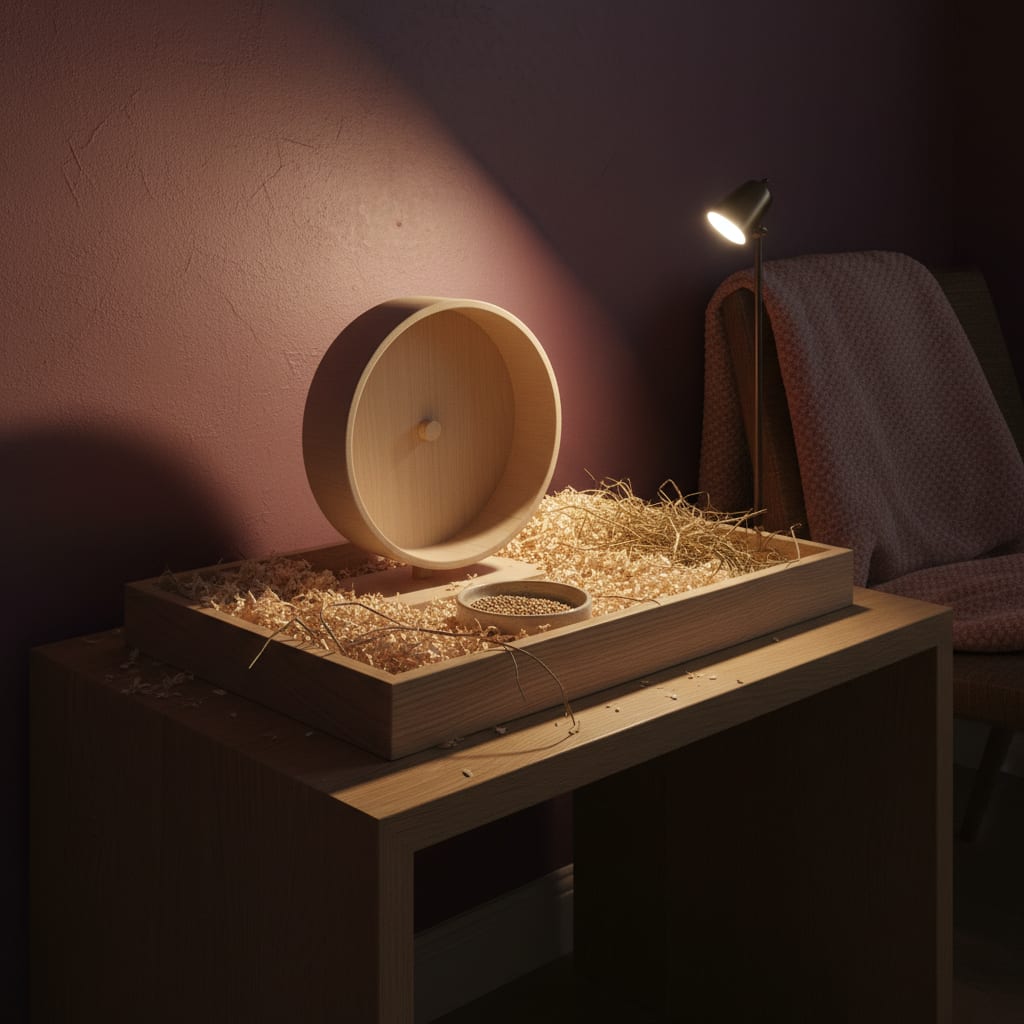
If a hamster wheel is waking your child, or you, at two in the morning, the fix is not to take the wheel away. Welfare guidance treats a running wheel as something a hamster needs, and the night is when it uses it. The fix is to move the cage out of the room where somebody sleeps, and to make sure the wheel it has is a solid, large one that fits the animal. And if a child under five sleeps in that room, the CDC’s guidance on rodents is a reason to move it whatever the noise.
Why 2am is the hamster’s rush hour
Nobody buys a hamster expecting a night-shift worker, but that is what arrives. The PDSA says hamsters “tend to sleep during the day and are active in the evenings/at night.” The RSPCA puts the wild version starkly: hamsters “are usually only active at dusk and night-time and can run up to five miles a day.” The Royal Veterinary College’s hamster care sheet calls them “generally nocturnal.”
So the cage on a child’s chest of drawers holds an animal on the opposite timetable from its owner, starting its working day roughly when your child is supposed to stop theirs. The drum of the wheel is not a malfunction. It is the hamster doing what it is built for, three feet from a pillow.
Why the wheel stays
The tempting fix is to lift the wheel out at bedtime. The welfare sources point the other way. The RSPCA lists “a running wheel” in its checklist of what a hamster needs, next to “plenty of space to play and exercise at night.” The RVC sheet says “wheels and toys should be provided.” Taking the wheel out at night removes it during the only hours the animal is awake to use it, which is the same as not having one.
What the sources are specific about is which wheel:
- Big. The RSPCA wants “a large diameter, such as one intended for rats.” The PDSA gives minimums of at least 20cm (8in) for dwarf hamsters and at least 30cm (12in) for Syrians, and warns that a wheel too small forces the hamster “to run with a curve in their back which can cause long-term pain.”
- Solid. The PDSA says it “needs to have a solid surface to run on, not slats or bars.” The RSPCA asks for “a solid structure and axle-free,” ideally with a non-slip running surface, and the RVC says wheels “should also be of a solid type and suitable size to prevent injuries.”
That is the spec to buy against; quietness is a bonus, not a substitute. As one widely sold example, the Kaytee Silent Spinner in the 12-inch size is a solid wheel sold for rats and chinchillas, which is the size class the RSPCA points to. Whatever you choose, check it against the measurements above rather than the word “silent” on the box.
The bedroom is the problem, not the wheel
The RSPCA’s guide to a hamster’s home wants it housed “in a quiet place where they can rest undisturbed,” in a room “where the lights go off at more or less the same time each night.” It also says hamsters “should be housed away from household objects that can generate ultrasound, such as televisions, computer screens, vacuum cleaners or sources of running water,” because they are “very sensitive to high-frequency sounds that we can’t hear.” The PDSA’s version: somewhere “quiet, calm, and away from anything noisy such as the TV or washing machine,” kept at a steady 18-21°C, away from draughts and direct sunlight.
A busy child’s bedroom fails that test from the hamster’s side as much as yours, so moving it is good for both parties: a spare room, a landing corner or a study that is calm by day, dark at a regular hour by night, and away from the television and the washing machine. One thing it should not be is the kitchen; the CDC says to keep small mammals and their equipment out of anywhere food is prepared, stored, served or eaten.
If you move it, do it in the evening. The RSPCA advises doing cage work when hamsters are awake rather than in the middle of the day, “when they are sleeping, as this disturbance can be stressful for them.”
If a small child shares that room
The CDC’s page on people at higher risk from animals says that “CDC recommends that children under 5 years old avoid contact with reptiles, amphibians, poultry (including chicks and ducklings), and rodents.” Hamsters are rodents. Its small-mammals page adds that these animals “can sometimes carry germs that can make people sick even when they look clean and healthy,” and, the line that matters for a shared bedroom: “You don’t have to touch a small mammal to get sick.”
So when an eight-year-old’s hamster lives in a room shared with a three-year-old, the noise is the smaller reason to move it. The CDC’s everyday rules: wash hands after handling the animal, its food or its supplies, and supervise children’s handwashing; don’t kiss or hold small pets close to the face; and clean the cage and equipment outside if you can, or in a laundry sink or bathtub that you clean and disinfect afterwards, never where food is prepared. The PDSA adds that children should always be supervised when handling hamsters.
If you are still at the choosing stage, Betteroo has a straightforward guide to which pets suit which ages; it puts hamsters at around eight and up, for the nocturnal reason above.

Your end of the 2am wheel
What the care sheets do not say is who is awake at two. In a lot of houses it is the adult who also tops up the water bottle, remembers the spot-clean and buys the bedding. The RSPCA is blunt that “looking after a hamster is too much responsibility for a child” and that an adult should always be responsible. So the pet that was meant to teach responsibility has, quite properly, become one more domain in the load you already carry, and now it is costing you sleep too.
Say that plainly at home: it turns “the hamster is annoying” into “this is a job, and it is mine by default”, and moving the cage is a job someone else can own end to end.
And if the noise still reaches you after the move, cover it rather than fight it. The same masking logic in our piece on the child who only sleeps with the dryer on works for an adult bedroom, with the same advice about volume and distance.
One more thing worth knowing gently: the RSPCA says hamsters usually live for up to two years, and the PDSA says about two to three. If the first death in your house turns out to be this small night-shift worker, the bedtimes afterwards have their own shape, and our piece on the first nights after a pet dies is there when you need it.
One small thing this week: pick the room the cage will move to, check it for a TV, a washing machine and a kitchen, and move it in the evening while the hamster is awake.
FAQ: the hamster wheel at night
Should I take the hamster’s wheel out at night?
No. The RSPCA lists a running wheel among a hamster’s needs, and night is when hamsters are active. Move the cage out of the bedroom instead.
Can a hamster live in a child’s bedroom?
It is a poor fit on the welfare guidance alone: the RSPCA and PDSA both want a quiet, calm room where the hamster can sleep undisturbed by day. And the CDC recommends that children under five avoid contact with rodents, so a room shared with a younger sibling is a second reason to move it.
How do I make a hamster wheel quieter?
Buy the right wheel first: solid, with no slats or bars, at least 30cm for a Syrian and 20cm for a dwarf, per the PDSA. Then move the cage to a room nobody sleeps in.
Is a hamster a good pet for a toddler?
Not on the CDC’s guidance, which recommends that children under five avoid contact with rodents. The RSPCA also says an adult should always be responsible for a hamster’s care.
Three Good Reads
How to Stop Revenge Bedtime Procrastination as a Mom
How to stop revenge bedtime procrastination as a mom — why you scroll until 1am after the kids sleep, and how to get a real evening back instead.
July 17, 2026
SAHM Burnout: When Home Is Also Your Job
Stay-at-home mom burnout, explained by someone in it — why the no-off-switch structure of SAHM life causes it, and how to build recovery back in.
July 17, 2026
Toddler Singing in the Crib After Bedtime: Do You Go In?
A toddler singing in the crib for an hour after lights-out is usually content. When to leave it, when it means bedtime is early, and how to start your evening.
October 7, 2026