Spending Money You Didn't Earn (The Feelings Part)
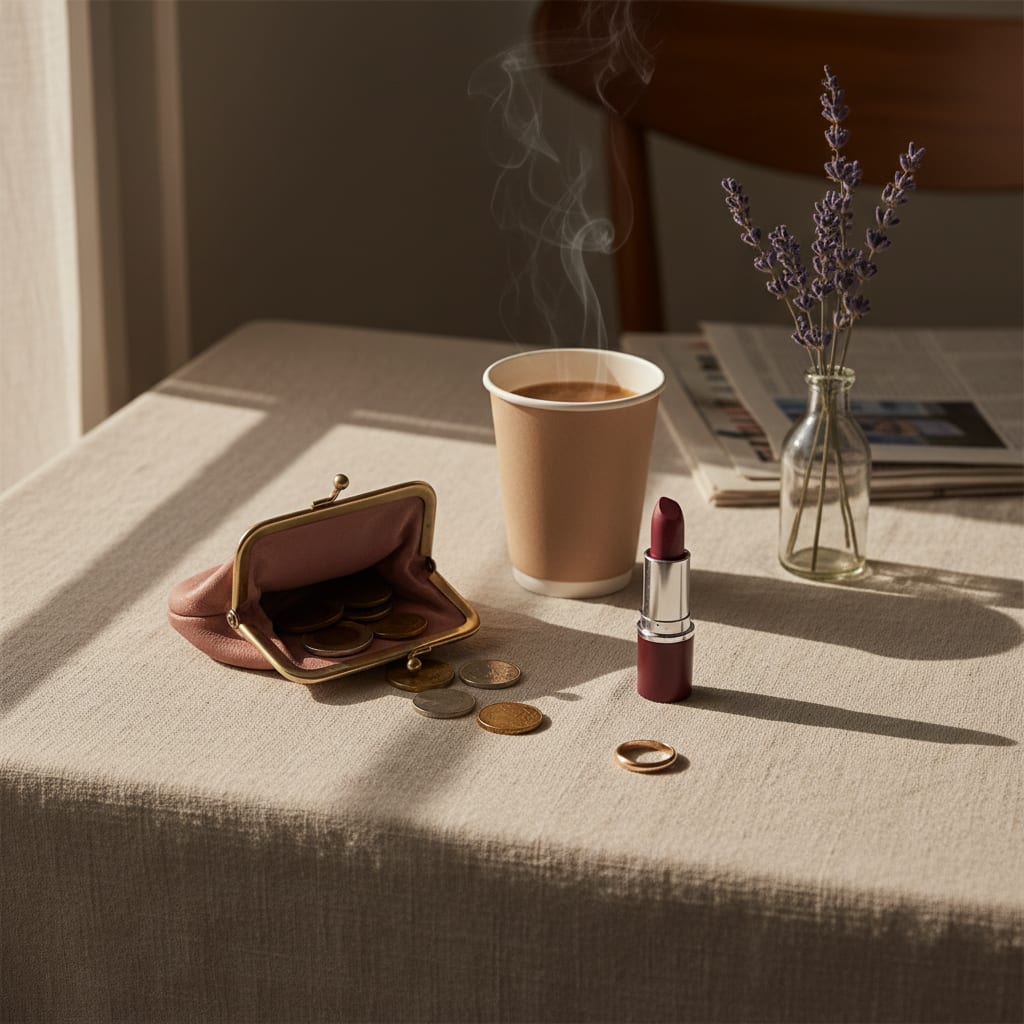
Buying yourself a $12 lipstick with money you didn’t personally earn can produce a flinch that a $200 grocery run never does — and the reason isn’t budgeting. Household money is jointly earned by two people doing different jobs, and almost every stay-at-home mom knows that intellectually while still feeling like a guest at the account. The flinch is about worth, visibility and permission, not arithmetic. It’s also fixable, mostly through language and a couple of structural decisions, and it does not require either of you to become a better person about money.
What the flinch actually is
The tell is that it’s selective. I could spend without hesitation on anything defensible — diapers, shoes, a birthday present for a party we barely wanted to attend. The hesitation showed up exclusively for things whose only justification was that I wanted them. A good coffee. A book. A haircut that cost what haircuts cost.
That’s not frugality. Frugality is consistent. What that pattern actually reveals is a private rule I’d never said out loud: spending on the family is legitimate because it’s for them; spending on me needs a receipt I can defend, because I didn’t bring the money in. Three things feed that rule.
Unpaid work is invisible in dollars. His contribution has a number attached and lands in an account on a schedule. Yours has no line item, so at some quiet level it doesn’t get counted as a contribution — even though it substitutes directly for money the household would otherwise be paying out.
We were taught that spending money is earned money. Most of us absorbed, well before marriage, that autonomy comes from a paycheck. Then the paycheck goes and the belief stays, quietly.
Asking makes you into an applicant. Anything you must request permission for, you experience as a favor, even when the person granting it is delighted to. The mechanism does the damage regardless of his warmth.
The flinch is never about the twelve dollars. It’s about whether you count as an earner in your own house.
The reframe that survives contact with a bad week
The one that holds up isn’t “your work is priceless” — priceless things famously have no price and pay for nothing. It’s blunter: you are half of a two-role business, and the household income is the revenue of both roles.
He converts hours into money. You convert hours into care, logistics and continuity the household would otherwise have to purchase. Neither role produces income alone: without his hours there’s no revenue, without yours the operation stops. The money that arrives is the output of both, which makes it ours in a legal and practical sense, not a generous sense. (The actual numbers side of that — real budgets, the arithmetic of running on one income — belongs to the practical desks; One Mom’s Guide has the ledger version of living on one income. This is the feelings half.)
The second reframe is smaller and does surprising work: the money isn’t his by proximity to the transaction. He touches it on the way in; that’s a mechanical fact about direct deposit, not a claim of ownership. Whoever’s name the deposit lands under is a banking detail, not a verdict about who the money belongs to.
Structures that dissolve the ask
Feelings follow structure faster than they follow speeches. Three changes do most of the work.
A no-questions personal amount for each of you. Same number, both people, spent without explanation, no reporting. The equality is the entire point — if only one of you has an allowance, you’ve built the applicant relationship into the furniture. Twenty dollars a month works if that’s what there is; the amount matters much less than the symmetry.
Joint everything above a threshold. One shared account, and a jointly agreed number above which either of you gives the other a heads-up — $150, $300, whatever fits. Below the line, either adult spends without a conversation. That single rule is what turns you from an applicant back into an account holder.
Say the sentence out loud, once, together. “This is our money. You earn it and I earn it in different currencies.” Corny, and it does something. Most husbands I’ve heard about are startled to learn their wife felt like a guest at the account; a lot of them assumed the joint account said everything that needed saying.
And notice if it’s more than a private flinch. If he tracks your spending, requires justification you don’t require of him, or restricts your access to household money, that’s financial control rather than a feelings problem — and it belongs with a professional, not a reframe. The National Domestic Violence Hotline (1-800-799-7233) handles financial abuse calls too.
The worth question underneath
Here’s the part I’d want said plainly: the reason a lipstick can make you flinch is that money is the loudest score our culture keeps, and you’ve stepped off the board. That’s disorienting in a way nobody warns you about. It shows up as guilt, and it’s often closer to grief — for the version of you who bought whatever she wanted on a Tuesday and told nobody.
Two true things sit side by side. Your household is better off financially because of what you do, in ways an itemized list would only partly capture. And you would deserve twenty dollars of unexamined joy a month even if it weren’t. If the flinch has hardened into a general sense that you cost more than you contribute, that’s worth watching — chronic worthlessness is one of the plainer warning signs of depression, and it’s a good reason to talk to your doctor or a therapist. In the US, the 988 Suicide & Crisis Lifeline (call or text 988) and Postpartum Support International (1-800-944-4773) are both there for the harder end of that.
One small thing this week: buy the small wanted thing without constructing a justification for it, and notice what your brain does. That flinch is data — and it’s worth naming out loud rather than filing in the ledger for later.
FAQ: money feelings as a stay-at-home mom
Is it normal to feel guilty spending money I didn’t earn?
Extremely common, and it says nothing about your marriage’s health. It comes from unpaid work having no dollar figure attached, plus a lifetime of learning that spending autonomy comes from a paycheck. The guilt is a habit of accounting, not an accurate reading of who contributed.
Should a stay-at-home mom have her own spending money?
An equal, no-questions personal amount for each partner is the single most effective fix I know for the applicant feeling — and equal matters more than large. When only one adult has discretion, the structure quietly says one person’s wants require approval.
How do I talk to my husband about feeling like it’s not my money?
Say it directly at a calm hour, with no accusation attached: “I know it’s ours, but I feel like a guest at the account, and I want to fix that.” Then propose one structure — equal personal amounts, or a threshold above which either of you gives the other a heads-up. Most partners are surprised by the feeling and glad to have something concrete to change.
What if my husband controls the money?
There’s a real difference between a spouse who’s anxious about money and one who uses it for control — the second means monitoring your spending, requiring justifications he doesn’t offer in return, or limiting your access to accounts and information. That’s financial abuse, it’s a recognized pattern, and it isn’t solved by better conversations. The National Domestic Violence Hotline, 1-800-799-7233, is the right call.
Three Good Reads
How to Stop Revenge Bedtime Procrastination as a Mom
How to stop revenge bedtime procrastination as a mom — why you scroll until 1am after the kids sleep, and how to get a real evening back instead.
July 17, 2026

Mom Groups When You Hate Mom Groups
Hate mom groups but still need people? The smaller, saner kinds of mom groups worth trying — and how to use one to find your two real friends inside it.
July 19, 2026
Overstimulated Mom: When Every Sound Is Too Much
Being an overstimulated mom, explained — why kid noise, touch and mess overload your nervous system, and quick ways to decompress in the middle of the day.
July 17, 2026