Overstimulated Mom: When Every Sound Is Too Much
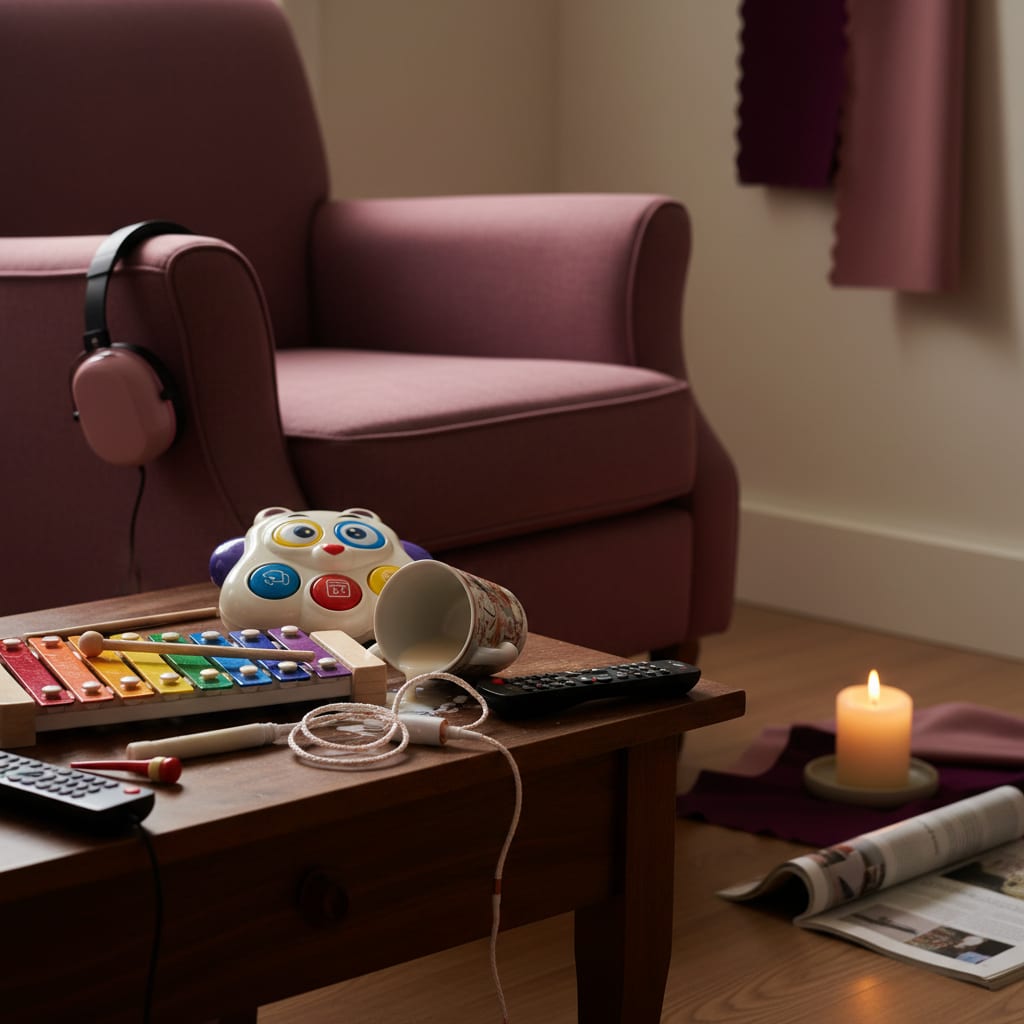
An overstimulated mom is a mom whose senses have taken in more than her nervous system can process — too much noise, touch, mess, and simultaneous demand — until every new input lands like a poke on a sunburn. It’s why the tag on your shirt, the cartoon theme song, and a fourth “mommy?” can combine into sudden, shaking rage or tears over objectively nothing. You’re not broken and you’re not ungrateful. You’re a human sensory system running hours past its limit — and there are faster ways to bring it down than waiting for bedtime.
What overstimulation actually is
Your senses have a budget. Every sound, touch, visual mess, and interrupted thought spends from it, and small children are world-class spenders: the show playing to no one, the toy that beeps in three keys, a person on your hip, another narrating at volume, snack requests arriving like radio static. None of it is bad. All of it is input, and input is cumulative.
When the budget runs out, the system doesn’t politely decline new input — it flags everything as threat. That’s the moment the sock seam becomes unbearable and the happy shrieking makes your shoulders climb to your ears. From the inside it feels like this: your skin is one size too small, sounds have edges, and you want — with an urgency that scares you — for everything to stop touching you and stop making noise. If the touch part is the loudest, that has its own name and its own essay.
Two things are worth saying plainly. First, this is a sensory state, not an emotional verdict — being overstimulated by your children is not a measurement of your love for them. Second, it stacks: an already burned-out mom starts each day with a smaller sensory budget, which is why the same Tuesday that was manageable in April is unbearable in July. If it helps to see the state in someone else’s words before you try to fix it, Betteroo keeps a page of short lines for the full-volume, touched-out end of the day; a few of them say in one sentence what this paragraph takes five to say.
Overstimulation isn’t a mood. It’s a full inbox refusing new mail.
The mid-day decompressions that actually work
Waiting for bedtime is a strategy, but it’s a bad one — nine more hours on a blown budget is how overload curdles into the rage flare. What works better is small, immediate subtraction of input. My tested list:
- Cut one sense at a time. You usually can’t silence the room, but you can dim it: lights off, curtains half-drawn, the background show actually off (nobody was watching). One sense’s worth of relief is real relief.
- Sixty seconds of a closed door. Bathroom, pantry, laundry room. Kids safe, timer on, lights off, hands over ears if you need it. It feels absurd. It works — you’re not escaping your children, you’re emptying an inbox.
- Drop your volume and slow your voice. Counterintuitive mid-chaos, but your own loudness is also input — to you. Whispering to a toddler also, mysteriously, often makes the toddler whisper.
- Headphones, one ear. Brown noise or nothing at all — a foam earplug like Mack’s Ultra Soft in one ear during the loudest stretches takes the edge off the sound budget while keeping you fully on duty.
- Touch moratorium with a script. “Mommy’s body needs a break — sit next to me and we’ll read.” Next-to instead of on-top-of is a legitimate accommodation, not a rejection.
- Get to bigger air. Outside, noise stops echoing and mess stops being visible. Same children, same volume, a fraction of the input. The backyard at 4pm is a decompression chamber disguised as a chore.
Playing defense: shrinking tomorrow’s input
Decompression is triage. The longer game is lowering the baseline: toys that make noise can lose their batteries (a tragic accident, batteries are like that); one show at a time, off when unwatched; visual clutter in bins because mess is input even when you’ve stopped consciously seeing it; and one genuinely quiet block built into the day — theirs and yours — so the budget gets a mid-day deposit instead of only withdrawals.
And watch the evening, because this is where overstimulation quietly steals twice. A mom who’s been over-inputted all day often can’t wind down at night — wired, skinless, scrolling in the dark — which burns the recovery window that would have refilled tomorrow’s budget. If that loop sounds familiar, the evenings-back plan is written for exactly it.
If the overwhelm feels constant rather than situational — if you’re maxed out from the first hour, every day, or the rage that rides in with it is frightening you — that’s worth a conversation with your doctor or a therapist rather than another coping list. Sometimes chronic overload has company (anxiety, depression, plain old untreated exhaustion), and sorting that out is care, not failure. Postpartum Support International (1-800-944-4773) talks to moms at any stage.
One small thing today: pick your closed-door spot and tell the kids the rule now, in peacetime — “sometimes mommy’s ears need a one-minute break” — so the first real deployment surprises no one.
FAQ: overstimulated mom
Why do I get so overstimulated by my kids?
Because parenting small children is one of the densest sensory environments there is — constant touch, layered noise, visual mess, and interruptions, for hours. Sensory load is cumulative, so a normal amount of kid input on an already-tired system still tips over the edge.
Is being overstimulated the same as being touched out?
They’re siblings. Overstimulation is the whole-system version — noise, touch, mess, demands together. Touched out is the same overload concentrated in physical contact. Same mechanics, same fixes, different loudest channel.
How do I calm down when I’m already overstimulated?
Subtract input fast: kill background noise and bright light, take sixty seconds behind a closed door with the kids safe, lower your own voice, get outside. Reducing one or two senses’ load is usually enough to step back from the edge.
Is it normal, or could it be something more?
Situational overstimulation that lifts when input drops is extremely common, especially in the little-kid years. If you’re overwhelmed from the moment the day starts, most days, or it comes with constant anxiety, flatness, or scary anger, bring it to a professional — that pattern deserves real support, not just earplugs.
Three Good Reads

How to Stop Comparing Yourself to Other Moms
Comparing yourself to other moms rarely tells you anything true. Why the feed hits harder when you're home all day, and how to stop scoring your life by it.
October 11, 2026
What Nobody Tells You About Being a Stay-at-Home Mom
Why being a stay-at-home mom is so hard: nine things nobody tells you — the loneliness, the missing edges, the boredom guilt and the money feelings, named.
August 11, 2026
Dreading Trash Day: When the Truck Wakes Your Child Weekly
The recycling truck wakes your child at the same hour every week. Why a morning you can see coming costs more than a random one, and how to plan it ahead.
September 23, 2026