SAHM Burnout: When Home Is Also Your Job
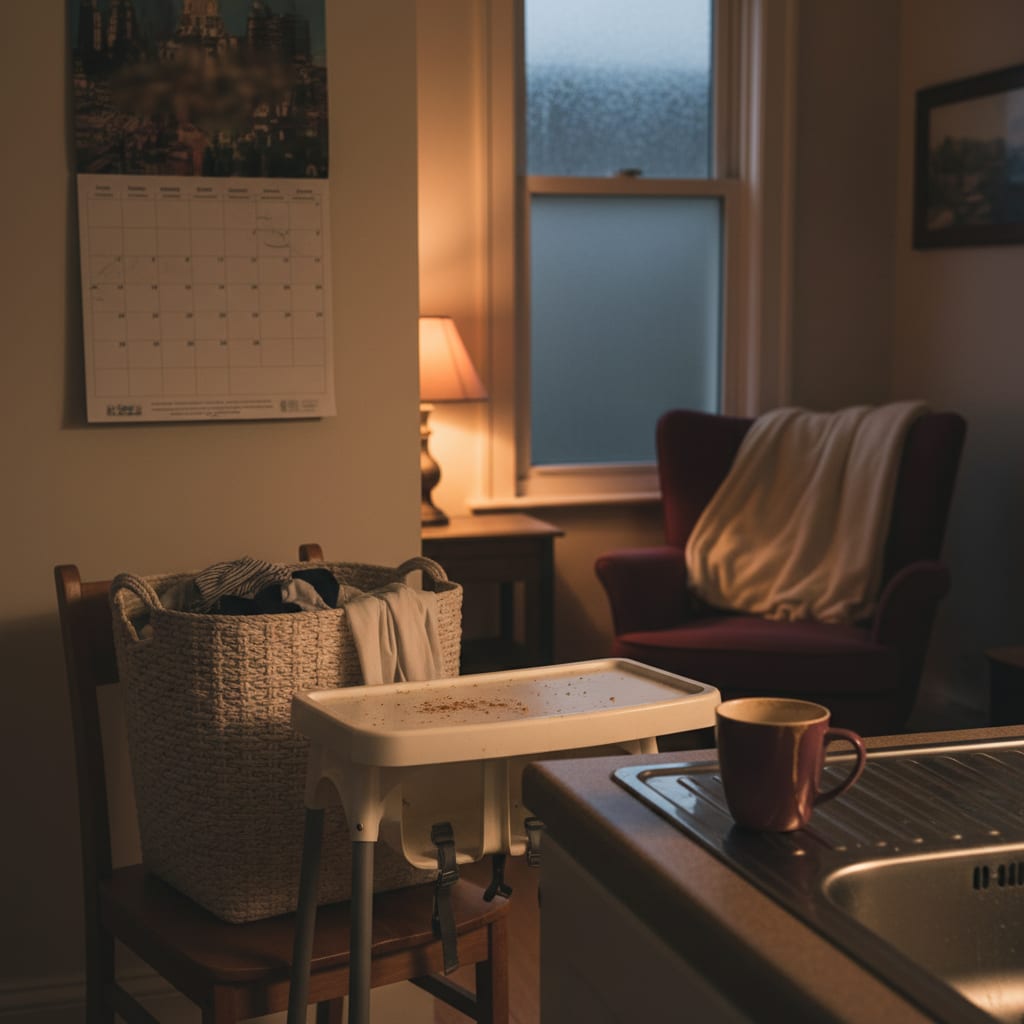
Stay-at-home mom burnout is what happens when your workplace, your break room, and your bed are the same square footage — deep exhaustion, a vanishing fuse, and a going-through-the-motions flatness that a night’s sleep doesn’t fix. It hits SAHMs in a particular way because the job structurally never ends: no commute to mark the shift change, no colleagues, no one clocking your overtime. The fix isn’t loving your kids harder or optimizing your mornings. It’s rebuilding the boundaries and recovery windows the job description quietly deleted.
The job with no edges
Every job I had before this one had edges. A door I walked out of. A lunch that was legally mine. A person who occasionally said “good work.” Staying home has none of that architecture, and it turns out the architecture was doing something: it was telling my nervous system when it was allowed to stand down.
At home, the shift never ends; it just changes lighting. You’re on at 5:50am and you’re on at 3am when someone’s dreaming about wolves. Even the recovery slots are conditional — naptime is yours if the nap happens, the evening is yours if bedtime doesn’t dissolve. Living permanently on-call does something distinct from ordinary tiredness. It builds the full burnout picture — the flatness, the too-loudness of everything, the stranger in your own kitchen wearing your bathrobe — one edgeless day at a time.
There’s a particular SAHM flavor to it, too: the invisibility. The work you did today will be fully undone by 9am tomorrow, and the only performance review is a toddler screaming that you peeled the banana wrong. Nobody’s clapping, and the work nobody can see keeps running in your head all night anyway.
The house is the office, the office never closes, and HR is a toddler.
Why “just take a break” keeps not working
Everyone’s advice is a break, and they’re not wrong — they’re just skipping the hard part. A break at home isn’t rest if you can hear the negotiation happening downstairs; that’s just supervising with extra steps. A hobby isn’t rest if you spend it braced for the door. For a break to actually repay recovery debt it needs three properties: it’s predictable (your body knows it’s coming), it’s protected (nobody can casually cancel it), and it’s genuinely off (out of earshot, or with someone else fully in charge).
Which is why the evening matters so much for SAHMs specifically. It’s the only daily window that can reliably have all three properties — but only if the kids’ bedtime actually ends on time. A bedtime that sprawls until 9pm eats the recovery window that was supposed to fix the day that caused the sprawl. If your evenings keep dissolving that way, getting your evenings back is the practical playbook, and the upstream fix — a kid sleep schedule that’s actually right for their age, which is what Betteroo builds and keeps adjusting — is the difference between an evening that starts at 7:45 and one that never starts at all.
Rebuilding the edges
Put a shift change in the day. If you have a partner, the day needs a moment where the baton visibly passes — a real handoff, not a drift. “From 7 to bedtime, you’re on and I’m off duty” twice a week is worth more than a vague promise of “help.” If you’re solo some or all nights, the shift change is with yourself: a lights-down, door-closed ritual that tells your body the workday ended.
Schedule the off-site. One block a week, out of the house, alone or with adults, non-negotiable and boring in its reliability. Library, long walk, a coffee with the friend who also needed rescuing. It’s not a treat. It’s the staff meeting where you remember you’re a person.
Lower the invisible quotas. You are almost certainly running standards nobody assigned you — enrichment quotas, dinner complexity, a floor-cleanliness bar set by a version of you with staff. Pick two and drop them, out loud, this week. Announced subtraction is the cheapest recovery there is.
Fix the day’s shape, not just its feelings. A shapeless day leaks energy everywhere; a rhythmic one at least burns predictably. The systems half of this problem is One Mom’s Guide’s beat, and their realistic SAHM schedule is the rebuild-the-day resource I point people to while I handle the feelings half here.
And mind the line. If the flatness has become hopelessness, if you’re numb most days, or anything in your head frightens you, that’s beyond burnout’s jurisdiction — bring in a doctor or therapist. Postpartum Support International (1-800-944-4773) takes calls from moms at every stage, not just postpartum, and 988 (call or text) is always staffed. This site is field notes, never a substitute for actual care.
One small thing tonight: decide where tomorrow’s shift change goes — the specific time the workday ends even though you’re still home — and tell one person so it exists outside your head.
FAQ: stay-at-home mom burnout
Is SAHM burnout real burnout?
Yes. Occupational burnout is what chronic, under-recovered workload does to a human, and SAHM life is a workload with no shift end, no colleagues, and no feedback — textbook conditions. The lack of a paycheck doesn’t make the load lighter; it mostly makes it less visible.
Why am I burned out when I “don’t even work”?
Because you work the longest unstaffed shift in the economy, and the phrase in quotes is the problem, not you. Invisible work still spends energy; unwitnessed effort still needs recovery. Burnout tracks load minus recovery — it has never once checked for a W-2.
What helps SAHM burnout fastest?
Reliability, not grand gestures: a bedtime that ends on time so the evening exists, one protected out-of-the-house block a week, a visible shift change, and two deliberately dropped standards. Small and dependable beats big and occasional.
When should I get professional help?
If weeks of genuine recovery attempts change nothing, or the exhaustion comes with hopelessness, persistent numbness, or thoughts that scare you — go now rather than later. Your doctor, a therapist, PSI (1-800-944-4773), or 988 are all right doors.
Three Good Reads
Overstimulated Mom: When Every Sound Is Too Much
Being an overstimulated mom, explained — why kid noise, touch and mess overload your nervous system, and quick ways to decompress in the middle of the day.
July 17, 2026
When the Family Pet Dies: The First Two Weeks of Nights
A pet's death is often a child's first bereavement, and bedtime is where it lands. The empty basket, the guilt at 8pm, and the grief nobody sends a card for.
September 3, 2026
How to Stop Revenge Bedtime Procrastination as a Mom
How to stop revenge bedtime procrastination as a mom — why you scroll until 1am after the kids sleep, and how to get a real evening back instead.
July 17, 2026