When All Your Friends Still Have Jobs
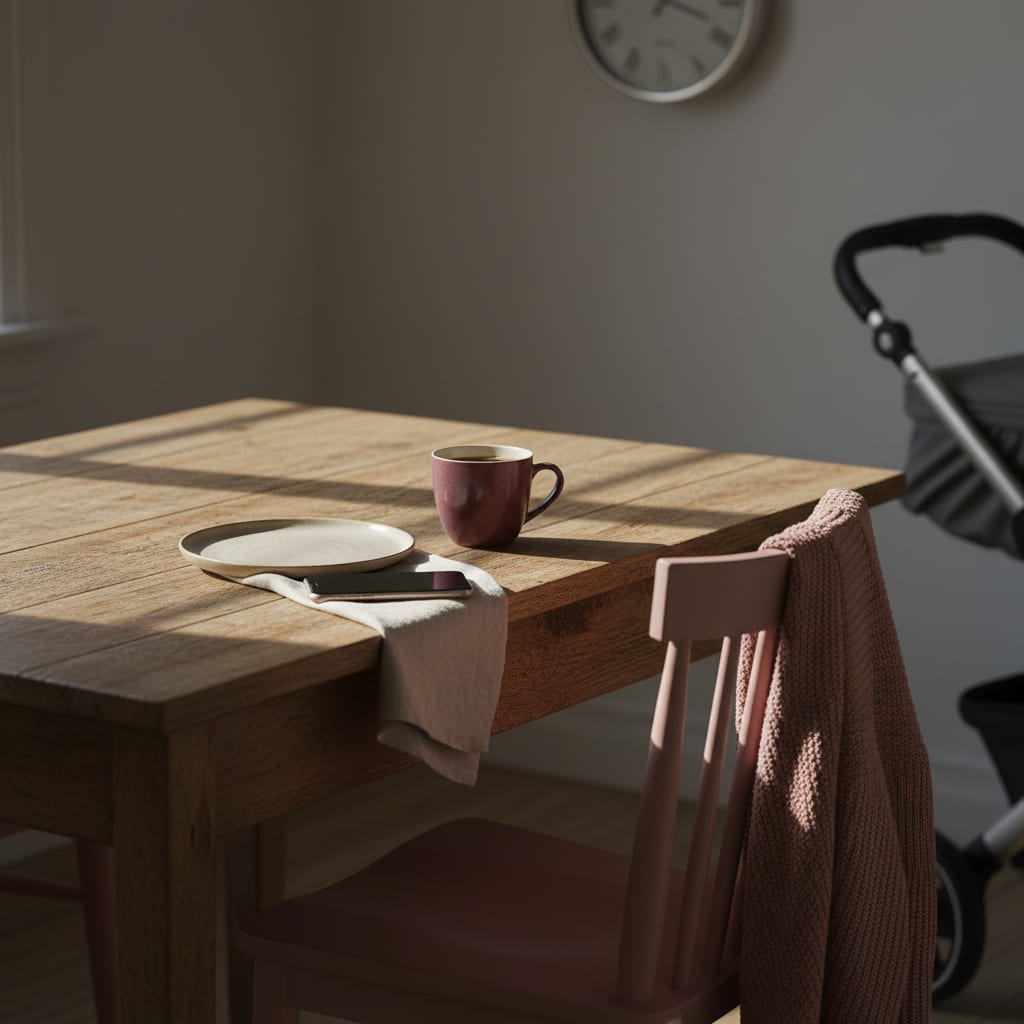
When all your friends still have jobs, the loneliness has a very specific shape: it’s 2pm on a Tuesday, the baby is asleep, you have forty free minutes and a full heart, and every single person you’d call is in a meeting. The fix is twofold, and neither half is “make new friends, obviously.” First, you renegotiate the working friendships onto hours that exist for both of you — because most of them can survive the schedule change even though they can’t survive silence. Second, you slowly add people who share your clock. Here’s how to do both without feeling like you’re auditioning.
The 2pm problem, named plainly
Nobody warns you that staying home doesn’t just change your income and your job title. It changes your time zone. You now live somewhere your old friends visit on weekends, like an expat. Their texts arrive at 6:15pm — the exact center of the witching hour, when you have a toddler on your shin and a pot boiling. Your texts go out at 1:40pm and land in their meetings. You’re never free at the same moment, so the friendship starts running on missed calls and “we HAVE to catch up soon,” which is friendship’s way of coughing.
And underneath the logistics there’s a quieter ache that deserves naming: it can feel like they kept the life you left. The promotions, the lunches, the being-spoken-to-in-full-sentences. Some afternoons the loneliness isn’t just I miss her — it’s I miss being someone whose Tuesday looked like hers. That’s not pettiness. That’s grief with a schedule conflict, and it sits right next to the broader SAHM loneliness this site keeps a whole file on.
What actually kills these friendships (it isn’t the jobs)
Working friends and at-home friends lose each other through a very polite process: each side stops asking, out of consideration. She stops inviting you to Thursday drinks because you always have to arrange a sitter. You stop calling at lunch because she only gets thirty minutes. Both of you are being thoughtful. Both of you are quietly writing the friendship’s eulogy.
The other killer is symmetry-keeping — the unspoken rule that contact must be matched, call for call. On your new clock, symmetry is impossible. Someone has to over-function for a season, and it will probably be you, because you’re the one whose heart is free at 2pm. This feels unfair. It’s actually just logistics, and it’s temporary: when her maternity leave or her sabbatical or her own 2pm eventually arrives, the over-functioning tends to swap.
Renegotiating the friendship onto real hours
The working friendships that survive get moved, on purpose, to time slots that exist. Some that have worked in this house:
The commute call. Her drive home is your pre-dinner chaos, but her morning commute might be your stroller walk. A standing twenty-minute Tuesday call, phone in the cupholder and phone in the stroller cup, has kept one of my oldest friendships alive for two years.
The 9pm voice memo. Not a call — a memo, sent whenever, answered whenever. It carries tone and laughter the way texts can’t, and it’s naptime-and-after-bedtime compatible. It’s the single best tool for long-distance friendships, and a friend across town on the wrong schedule is, functionally, long-distance.
The recurring calendar invite. It feels absurdly corporate to send your college roommate a monthly invite titled “us.” Send it anyway. Working people live by their calendars; what’s on the calendar happens, and what’s “soon” doesn’t.
Say the quiet part. One honest sentence resets years of drift: “I miss you, our schedules are hostile, and I’d rather do weird tiny formats than lose you — can we try a standing walk-and-talk?” If asking first feels exposed, there are scripts for exactly this.
And still: you need someone who shares your clock
Keep the working friends — they hold your history, and they’ll come back to your time zone eventually. But no renegotiation fixes Tuesday at 2pm. For that you need at least one or two people who are also at the park at ten and free when you’re free, which means doing the slightly awkward work of making friends as a SAHM. Not to replace anyone. Old friends are the archive; clock-friends are the daily paper. A whole inner life needs both.
One small thing this week: pick the working friend you miss most and send one sentence — “Your Thursday commute, my stroller walk, twenty minutes, standing date?” — before you talk yourself out of it.
FAQ: friendship when your friends still work
Why did I lose my friends when I became a stay-at-home mom?
Usually nobody chose it. Opposite schedules mean every contact attempt lands at the other person’s worst moment, both sides stop asking out of politeness, and the friendship starves on “soon.” It’s a logistics failure far more often than a loyalty failure — which is good news, because logistics can be renegotiated.
How do I stay close to friends who work full-time?
Move the friendship to hours that exist for both of you and make it recurring: a standing commute call, 9pm voice memos, a monthly calendar invite, a Saturday-morning walk. Small, scheduled, and repeated beats long, spontaneous, and never.
Is it normal to feel jealous of my working friends?
Very. You can be glad you’re home and still ache for the version of Tuesday they kept — adult conversation, visible progress, lunch that’s hot. Treat the envy as information about what you’re missing, not proof you made the wrong call. Then get one of those missing things back on purpose.
Should I just find new mom friends instead?
Not instead — also. Old friends carry your history and don’t need the backstory; friends on your schedule can actually stand next to you at 2pm. The loneliest plan is expecting either group to do the other’s job.
Three Good Reads

The Default Parent: Why It's Always You
What a default parent is, why it's probably you, and how to rebalance — from the school's first phone call to the 2am wake-ups that only ever find your side.
July 17, 2026

Self-Care for SAHMs That Isn't a Bubble Bath
Self-care for stay-at-home moms that isn't a bubble bath: why the spa version fails at home, the four kinds that actually restore, and where to start this week.
July 31, 2026

Burned Out or Something More? An Honest Check-In
Burned out or something more? An honest, experience-based check-in for stay-at-home moms — what burnout feels like, what feels different, and where to get help.
July 19, 2026