Checking the Baby Is Breathing at Night: Your Sleep Matters
Getting up to check the baby is still breathing is common in the early weeks. How to give the checking a limit, what safe sleep covers, and when it's anxiety.
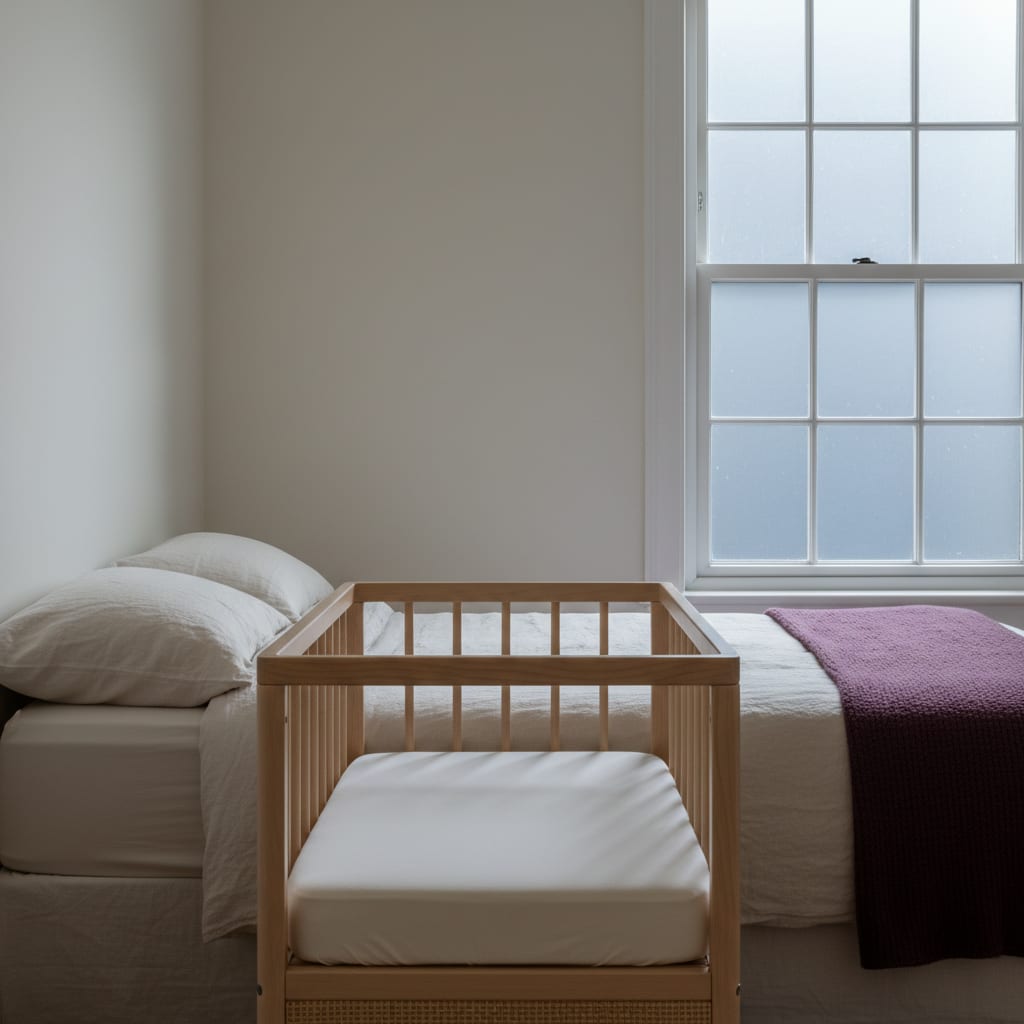
Getting up in the night to check that the baby is still breathing is one of the most common things new parents do, and in the first weeks it usually needs no fixing. It becomes a problem when the checking starts eating the sleep you need to look after the baby by day. The way out is not willpower. Set up the sleep space the way the safe-sleep guidance says, so you know the room is doing its job. Agree a limit on checking with yourself. And notice when the fear has stopped being ordinary new-parent worry, because that is when it is worth telling a doctor.
The 2am walk to the crib
You know the walk. You wake for no reason at all, and the house is too quiet. You lie still and listen, can’t hear anything, and get up. You stand over the bassinet in the dark waiting for the small chest to rise. It rises. You go back to bed, and twenty minutes later you do it again.
Almost every parent I know has done this, and many did it for weeks. It’s mostly love with nowhere to put itself. A baby who sleeps quietly is a baby you cannot hear, and newborn breathing can look alarming: a short pause, then a burst of quick breaths. If those pauses are what wakes you, the explanation of periodic breathing in newborns on Baby Sleep Central is a calm, useful read in daylight. It will not replace your pediatrician, who is the right person for any breathing worry.
Let the room carry some of the worry
The checking feels like the thing keeping the baby safe. It isn’t. What protects a sleeping baby is how and where they sleep, and that is set up once, before bed, not checked twelve times after it.
The American Academy of Pediatrics’ safe-sleep guide on HealthyChildren.org and the NIH Safe to Sleep campaign agree on the basics:
- On the back, for all naps and at night.
- A firm, flat surface with only a fitted sheet. Nothing else in the crib or bassinet.
- In your room, but not your bed. Safe to Sleep puts it plainly: “Share a room with baby for at least the first 6 months.” The baby goes in “their own sleep space (crib, bassinet, or portable play yard) in your room, separate from your bed.”
- Never on a sofa or armchair. Safe to Sleep says: “Couches and armchairs are never safe places for babies to sleep.”
That room-sharing advice is also the kindest thing in the guidance for an anxious parent. Safe to Sleep notes that keeping the baby’s sleep space close to your bed “makes it easy to check on, feed, and comfort baby without having to get all the way out of bed.” A bassinet within arm’s reach turns the 2am walk into a glance.
What about a breathing monitor?
This is where a lot of tired parents land, and it is worth being clear. The AAP’s guide says: “Don’t use home cardiorespiratory monitors as a way to reduce the risk of SIDS.” It adds that there is no evidence that consumer heart-rate and pulse-oximetry devices “decrease SIDS risk”, and warns: “Don’t let these devices give you a false sense of security.” Safe to Sleep says the same: these monitors “are not effective at detecting or preventing SIDS.”
So I’m not going to recommend one. If your pediatrician has prescribed monitoring for a medical reason, that’s a different situation and their advice comes first. For everyone else, the safe-sleep set-up above is the protection.
Give the checking a limit
Checking is not wrong. Unlimited checking is the problem, because it never tells you when you’re finished. A few limits parents I know have used:
- Check once, properly, before you sleep. Back, flat, bare sheet, close by. Then tell yourself, out loud if it helps: the room is set.
- Look, don’t touch. Watching from the bed is a check. Lifting the blanket edge, putting a hand on the chest or moving the baby is how a check turns into a wake-up for both of you.
- Hand over the night with the job. If your partner is on duty, they’re on duty for the checking too. This is where a written night-shift swap earns its keep. Betteroo’s guide to splitting nights includes a set of safe-sleep rules written for exhausted parents at 3 a.m., and the on-duty parent should be the most awake adult in the house.
None of this asks you to stop caring. It asks you to stop paying for the caring with the sleep that keeps you patient at 4pm.
 Nights that ask less of both of you
Betteroo builds a personalized sleep plan around your baby's age, so the nights get more predictable and you get longer stretches of your own sleep.
Take the free sleep quiz →
What it costs you to keep checking
The cost shows up in your day, not at 2am. Hours of broken, half-listening sleep leave you shorter-tempered and slower, and you are often the only adult on duty all day. The usual advice to sleep when the baby sleeps does not work if you spend the baby’s naps watching them breathe instead.
There’s a quieter cost too. Some of us start hearing things that aren’t there: a cry from the shower, a cry from the next room when the baby is asleep. The New Moms Club writes well about that phantom crying, and it belongs to the same family as the checking. It’s a brain tuned so tightly to one small person that it will not switch off.
When the checking is anxiety
Ordinary new-parent worry eases over weeks, as the baby gets bigger and you get used to the sounds. It is worth telling your doctor or midwife if:
- you can’t sleep even when someone else has the baby and the baby is safe;
- the fear is there most of the day, not only at night;
- you have frightening thoughts or images about the baby being harmed that you can’t push away;
- you feel on edge, panicky or unable to rest for more than a couple of weeks.
The National Institute of Mental Health describes perinatal depression as bringing “extreme sadness, anxiety, and fatigue”, and notes that feelings of anxiety or unhappiness “that are severe or last longer than 2 weeks after childbirth may be signs of postpartum depression.” It is treatable, and asking for help is not overreacting.
Postpartum Support International’s HelpLine is 1-800-944-4773, call or text. The National Maternal Mental Health Hotline is 1-833-852-6262, call or text, 24 hours a day. If you are in crisis or thinking of harming yourself, call or text 988, and in an emergency call 911.
One small thing tonight: before bed, do one full check of the sleep space, then say “the room is set” and get into bed.
FAQ: checking the baby is breathing
Is it normal to keep checking if my baby is breathing?
Yes, especially in the first weeks. It’s worth a conversation with your doctor if it stops you sleeping even when someone else is on duty, or if the fear is there most of the day.
Should I buy a baby breathing monitor?
The AAP advises against using home cardiorespiratory monitors to reduce the risk of SIDS, and says consumer devices have no evidence of lowering that risk. Follow the safe-sleep basics instead. If your pediatrician prescribes monitoring for a medical reason, follow their plan.
How can I sleep when I’m worried about SIDS?
Set up the sleep space once, properly: back to sleep, a firm flat surface with only a fitted sheet, in your room but not your bed. Keep the bassinet close enough to see from bed, and share night duty so the checking has a limit.
Quotes are from the AAP’s “A Parent’s Guide to Safe Sleep” on HealthyChildren.org, NIH Safe to Sleep’s “Ways to Reduce Baby’s Risk”, the NIMH’s “Perinatal Depression” and Postpartum Support International’s help page, all loaded on 2026-11-27. I’m an editor, not a clinician.