Stay-at-Home Mom Resentment: When He Gets to Leave
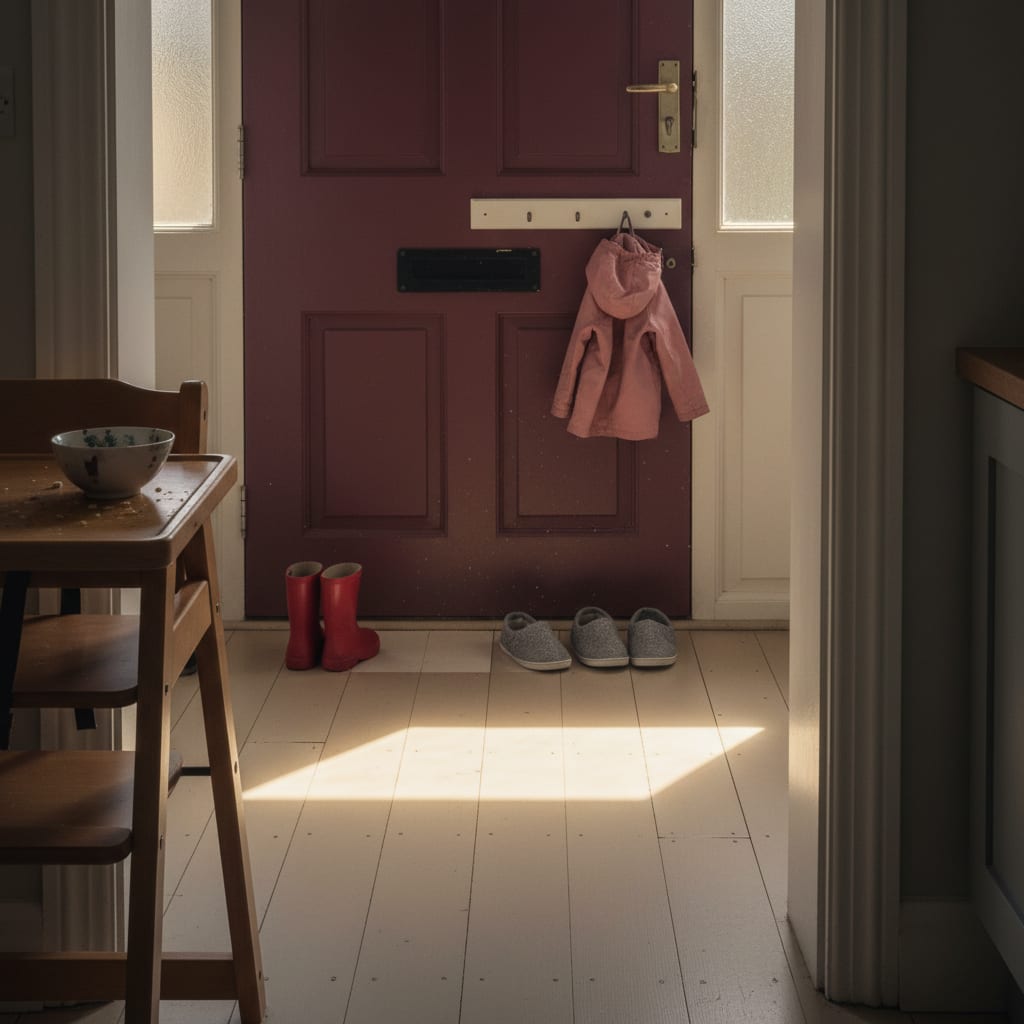
Resenting your partner for walking out the door in the morning is extremely common, and it is almost never about the walking out. It is about the fact that his day has edges and yours does not — a beginning, an end, a commute in between where nobody needs anything. The envy isn’t of his job. It’s of the transitions. Naming it that way matters, because “I resent him for leaving” has no fix and “I have no transitions and no solitude” has several.
The 8am moment, described accurately
He picks up his keys. There’s the specific rustle of a coat. The door does its two-part sound — the click and then the quieter settle — and the house changes temperature, and you are standing in the kitchen holding a small child and a bowl.
And something in you goes hot.
It doesn’t announce itself as resentment. It arrives as a flat, unfair little thought — must be nice — that you would not say out loud and are slightly ashamed of by 8:15. Then you get on with the day, and it comes back tomorrow at the same time.
The reason it goes unexamined is that it looks petty written down. He is going to work. He did not do anything. There is nothing to be aggrieved about, so the feeling gets filed as a character defect and buried — which is precisely how a small daily irritation turns into something that sits in a marriage for years.
What it’s actually pointing at
Take the feeling seriously for a second and it turns out to be quite specific. It is rarely a wish to have his job. Ask most women at home whether they’d swap into his exact role tomorrow, and the answer is a fast no.
What’s being envied is smaller and more precise:
A commute. Twenty-five minutes in which nobody speaks to you, nothing is your responsibility, and you are neither at the last place nor the next one. It is the only reliable solitude in most adult lives and it is invisible to the person who has it, who experiences it as traffic.
An end. His day finishes. Something happens — a car door, a train — that means the work part is over. Yours doesn’t finish; it merely gets quieter around 8pm and then resumes at 5:40am, and a job with no closing time is measurably harder to carry than one with the same hours and a hard stop.
A room where he isn’t anybody’s parent. He spends eight hours being addressed by his own name, in a context where his competence is legible and somebody occasionally says he did a good job. That version of him gets daily exercise. Yours gets whatever’s left.
Being missed. He gets to come home. Coming home requires having been somewhere.
None of those four are things he chose over you. They came attached to the arrangement, which the two of you almost certainly made together and for good reasons.
Why this is not a case against him
I want to be careful here, because this feeling has a well-worn slide into a much less useful one.
He is not having a lovely time. The commute he “gets” is often the only stretch he isn’t being asked for something either, and he’s paying for it with a job he can’t leave. Some men do carry far less than their share, and that is a real and separate problem — the ledger you do in the dark covers it properly, and if the issue is workload rather than autonomy, that’s the piece to read instead of this one.
But this resentment survives even in the fair households. That’s the tell. If he did fifty percent of everything and still left at eight, the hot feeling would still show up, because what’s being envied isn’t his effort level — it’s his access to being a person off-duty. Trying to solve an autonomy problem by relitigating the chore split is how couples end up in the who-has-it-harder trap, where nobody wins and both leave more tired.
And to say the other obvious thing plainly: none of this is an argument that you shouldn’t be home. You can be certain about the arrangement and still want twenty-five minutes where nobody can reach you.
What actually lowers it
Build your own leaving. Not an outing with the children, not a shop-with-a-list. An actual departure, at a fixed hour, where you go somewhere alone and come back — even ninety minutes on a Saturday. The point is the structure of it: the door, the elsewhere, the return. Doing things alone as an adult is a skill that atrophies fast and comes back with practice.
Manufacture a hard stop. Pick a time and make something happen at it. The kitchen light goes off. The laundry does not get folded after nine. It’s arbitrary and it works, because most of what makes an edgeless day heavy is that nothing ever declares it over.
Get the arithmetic out of your head. A surprising amount of the 8am heat is that he leaves and the whole operating system of the household stays resident in one skull — naps, windows, who eats what, what happens if the afternoon slides. Anything that moves that from your memory onto a page a second adult can read takes weight off, which is the honest case for using something like an age-by-age schedule someone else can follow rather than holding it all yourself. Written down, it stops being yours by default.
Change what happens at 6pm. A large share of morning resentment is actually unresolved evening resentment, deferred. If the handover when he walks back in is a wordless slide into his phone, the door in the morning will keep sounding like an escape.
Saying it without starting a fight
The version that fails: “It must be nice to just leave.” He hears an accusation about his job, defends the job, and you end up arguing about whose day is worse.
The version that works names the want rather than the grievance. I need one stretch a week where nobody can reach me. Can we make Saturday mornings mine? It’s concrete, it’s answerable, and it doesn’t require him to agree that his commute is a privilege — which he will never agree to, and which he doesn’t need to agree to for you to get the ninety minutes. Our piece on asking for what you need without a fight has more scripts in this register.
One small thing this week: tomorrow at 8am, when the door does its two-part sound, say the sentence in your head as a want instead of a complaint — I want an ending and twenty-five minutes — and then write down where in the week you could actually get them.
FAQ: resenting your partner for leaving
Is it normal to resent your husband for going to work?
Yes, and it shows up in good marriages as often as strained ones. It usually has nothing to do with his effort and everything to do with the difference between a day with edges and a day without them. Treating it as a defect in you is what keeps it around; treating it as information about missing transitions is what makes it manageable.
Does this mean I regret staying home?
Not by itself. Wanting solitude, an endpoint and a version of yourself that isn’t on duty are ordinary human needs that this arrangement happens to squeeze — you can want all three back and still be sure the arrangement is right. If the feeling is broader and heavier than the 8am flash, that’s a different question and worth sitting with separately.
How do I stop feeling jealous of his commute?
Get some version of it rather than trying to argue yourself out of it. A weekly hour alone that isn’t errands, a walk without the stroller, a drive with nothing at the other end. The envy fades in direct proportion to how much uninterrupted time you actually have, which is a more useful lever than willpower.
What if he doesn’t understand why I’m upset?
Skip the explanation and make a request. Most partners can’t follow a case about the invisible structure of a day, and nearly all of them can say yes to “I need Saturday mornings.” Understanding tends to arrive later, usually the first weekend he runs the house alone from six until noon.
Three Good Reads
How to Stop Revenge Bedtime Procrastination as a Mom
How to stop revenge bedtime procrastination as a mom — why you scroll until 1am after the kids sleep, and how to get a real evening back instead.
July 17, 2026

He Doesn't See the Invisible Work (Show, Don't Seethe)
When your husband doesn't see the invisible work at home, seething never fixes it. How to make the unseen labor visible — and hand parts of it over for good.
July 27, 2026
Hobbies That Survive Naptime (Actually)
Hobbies for stay-at-home moms that survive naptime: the four rules an interruptible hobby has to pass, twelve that qualify, and the ones to save for later.
July 31, 2026