Toddler Snoring and Teeth Grinding: Which Sounds Matter
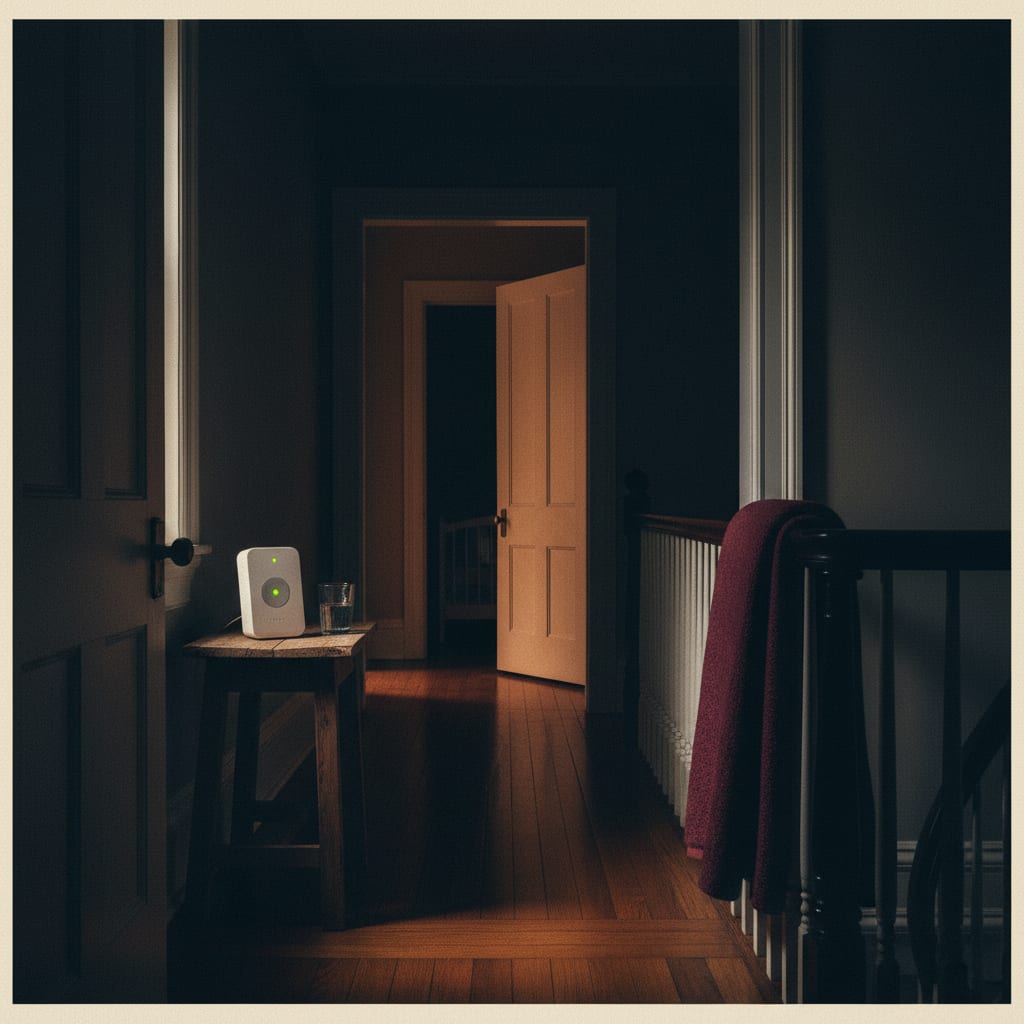
Most of the noises a small child makes at night are ordinary and mean nothing at all: grunting, sighing, snuffling, muttering, thrashing, the sudden loud sentence about a tractor. Teeth grinding sounds far worse than it is and is common in young children, most of whom simply stop. The one sound worth taking to a doctor rather than a search bar is snoring that happens most nights — habitual rather than occasional, outside a cold. That’s a conversation for your pediatrician, in daylight. Everything else here is noise you’re allowed to sleep through.
The listening shift nobody signed up for
There is a job that starts when you go to bed and it is not sleeping. It is listening — running every sound through an assessment, half-conscious, all night. Distressed or sleeping? The noise that becomes a wake-up, or nothing? Nobody hands you this job and nobody relieves you of it, and it persists long past the baby stage.
The cost is not the wakings; it’s the vigilance between them. You can be asleep for eight hours and arrive downstairs with five hours’ worth of rest, because part of the night was spent on duty — which is why the debt keeps building even on nights nobody got up.
So there’s a selfish reason to learn the noise floor: not to supervise more attentively, but to stand down. Knowing which sounds are nothing is what lets the listening switch off.
Learning the sounds isn’t about monitoring more closely. It’s about earning the right to ignore most of them.
The ordinary noise floor
Small children are appallingly loud sleepers, and almost all of it is unremarkable. Babies are the noisiest of the lot: newborn sleep comes with a running commentary — grunting, straining, squeaking, snorting — produced by immature breathing patterns and a digestive system working with the volume up. It’s the most misread sound in early parenthood, because all of it sounds like distress and hardly any of it is; the grunting stage and roughly when it settles is worth reading once, early, purely to stop yourself standing over a cot at 3am listening to normal digestion.
Toddlers swap the grunting for talking. Sleep talking is common, occasionally hilarious, and requires nothing from you. So does thrashing — the sideways migration, the abandoned pillow, the child found at 6am at ninety degrees to where they started. So do single shouts, brief crying that resolves inside a minute, and the theatrical sigh that makes you sit bolt upright. Congestion during a cold is its own category: loud, rattly, gone when the cold goes.
The practical rule for all of it: a sound that does not escalate is not a summons. Wait sixty seconds. Most of the noise floor resolves itself inside that minute, and going in converts a sleeping child into an awake one.
Teeth grinding sounds far worse than it is
Nothing in the small hours is as unnerving as bruxism: a slow bone-on-bone scrape that carries through a wall, sounds like structural damage in progress, and routinely sends parents into a night of quiet panic.
It is common in young children and most grow out of it without anything being done. Dentists see it constantly at this age and treat it as unremarkable; night guards, the standard adult answer, are generally not used on baby teeth. It worsens in busy stretches and eases in calm ones — the closest thing to a pattern most families find.
Worth mentioning at the next dental check-up, then, rather than at 2am: the dentist can look at the enamel and say whether anything is wearing. Beyond that the advice is unglamorous — grinding often tracks with being wound up or overtired, so the lever is a calmer, earlier landing into sleep rather than anything aimed at the teeth. If bedtime keeps arriving past the point of tiredness, the difference between overtired and undertired signals is where to start.
Snoring is the one to take to a doctor
Here is the sound that gets treated as cute and shouldn’t be. Occasional snoring is common and usually means very little — a cold, a stuffy nose, an odd position. Snoring most nights, over weeks, when nobody is ill, is different. It’s the one noise here with an actual medical conversation attached, and the move is unambiguous: mention it to your pediatrician, and book an appointment if none is coming.
I’m going to be deliberately unhelpful about the rest. Don’t try to work out what it means yourself, and don’t run a symptom search at 2am. Children’s sleep-related breathing is a clinical assessment with a straightforward path through it: your doctor asks the questions, decides whether anything further is needed, and very often the answer is reassuring. A search engine is not — it hands an exhausted mother the worst version of every possibility and no way to weigh it.
Related, and worth a look in daylight: breathing through the mouth rather than the nose at night tends to travel with habitual snoring, and it helps to describe it accurately in front of the doctor. Take an observation, not a diagnosis — that’s your whole job here.
The screams that aren’t what they sound like
The last category is the loudest and most misunderstood: the sudden, inconsolable scream a couple of hours after bedtime. If your child is sitting up with their eyes open, wailing, apparently awake and yet not recognising you — and remembers nothing in the morning — that’s the familiar pattern of a night terror rather than a nightmare, and the two are handled in opposite ways. A nightmare wants comforting: the child is awake, frightened, and knows who you are. A night terror wants nothing. Keep them safe from the edges of the bed, don’t wake them, wait it out. It is far worse for the adult in the room than for the child.
Terrors cluster in overtired stretches too — the thread running through all of this is that dramatic night noise gets louder when the day has run long. If the small hours have become genuinely unmanageable, that’s a different problem from noise, and the 4am waking has its own fix.
Two honest lines to end on. Most parents cannot tell these categories apart at night on four hours’ sleep — which is why this is a thing to read in daylight and remember dimly at 3am. And if you’re cycling nightly between noise, worry and contradictory advice, the exhaustion is coming as much from the deciding as from the sleep. An age-matched plan built by somebody else — which is what Betteroo does — takes that guesswork off you. Balanced view: it won’t quiet a grinding jaw, it has nothing to say about anything medical, and no plan survives a fever week. What it removes is the 2am arithmetic.
 Stop deciding at 2am
Betteroo builds a personalized, age-matched sleep plan and keeps adjusting it as your child grows — so the nightly guesswork stops being yours to carry.
Take the 2-minute sleep quiz →
Stop deciding at 2am
Betteroo builds a personalized, age-matched sleep plan and keeps adjusting it as your child grows — so the nightly guesswork stops being yours to carry.
Take the 2-minute sleep quiz →
One small thing tonight: pick one noise you currently get up for that you now believe is ordinary — the grunting, the sigh, the sixty-second cry — and don’t. Wait it out once. Proving the noise floor to yourself is what turns the listening off.
FAQ: night noises in babies and toddlers
Why does my toddler grind their teeth at night?
Grinding is common in young children and usually needs no treatment; most grow out of it, and it increases during busy or overtired stretches. Mention it at a routine dental check-up so the enamel can be looked at, but it rarely calls for more than a calmer bedtime.
Is it normal for a toddler to snore?
Occasional snoring — during a cold, or in an awkward position — is very common and unremarkable. Snoring most nights over several weeks, when your child is otherwise well, is worth raising with your pediatrician. That’s a conversation for daylight, not a question to research at 2am.
Should I go in every time my baby makes a noise in their sleep?
Usually not. Babies are extremely noisy sleepers, and most grunting, snuffling and brief fussing resolves without anyone entering the room. Waiting sixty seconds avoids waking a child who was never really awake — the single change that gives most parents back the most night.
What’s the difference between a night terror and a nightmare?
A nightmare wakes the child, who is frightened, knows you, and wants comfort. A night terror leaves them apparently awake but unreachable, with no memory afterwards. Nightmares are comforted; night terrors are kept safe and waited out. Both are common, and terrors are worse for the parent.
Three Good Reads

Mom Groups When You Hate Mom Groups
Hate mom groups but still need people? The smaller, saner kinds of mom groups worth trying — and how to use one to find your two real friends inside it.
July 19, 2026
Mom Friend Breakups: When a Mom Friendship Ends
A mom friend breakup is a real loss with no ritual around it. Why these friendships end, how to tell a fade from a rupture, and what to do with the grief.
August 11, 2026

Keeping Long-Distance Friendships Alive on Naptime Hours
How to keep long-distance friendships alive as a stay-at-home mom — naptime-sized rituals that hold real closeness when visits and long calls can't.
July 23, 2026