The 5-to-7 Handover: Surviving the Witching Hours
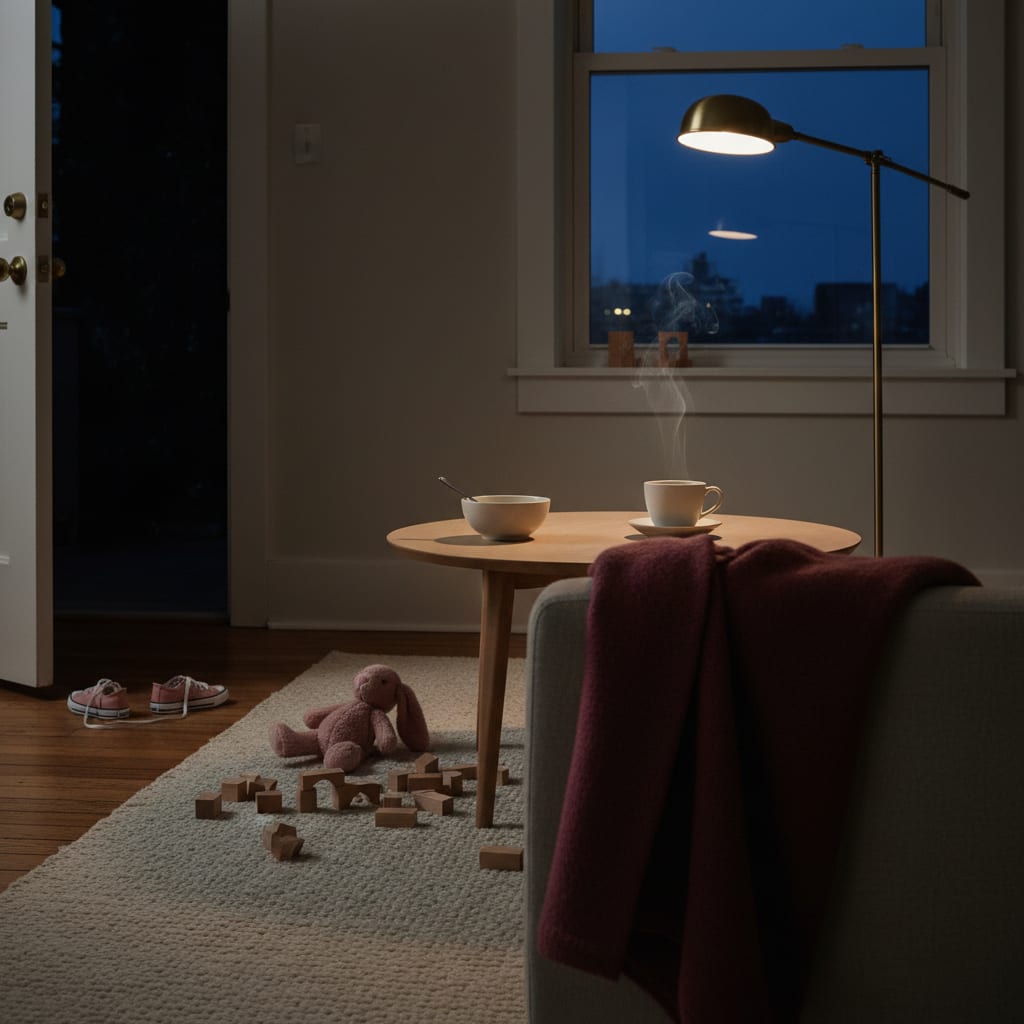
The two hours between five and seven have three jobs, and only three: get the leftover energy out of the child, turn the day’s input down, and hand one person to sleep and the other to her evening. Almost everything that goes wrong in that window goes wrong because it’s being asked to do something else as well — cook, tidy, answer messages, entertain, referee, produce a pleasant family scene. Strip it back to the three jobs and the witching hour doesn’t become lovely, exactly. It becomes survivable, and it stops eating the evening on the other side of it.
Why 5-to-7 is the hardest shift of the day
Every other job in the world hands over. The night nurse briefs the day nurse. The shift ends, someone else picks it up, and the person going home gets to stop being responsible for the outcome.
You don’t get that. At five o’clock you are eleven hours into a shift, running on whatever’s left, and the two hardest hours are still ahead — because they’re the hours when your children are also running on empty. Two depleted people, one of whom is legally responsible for the other. That’s the whole problem, and it’s why “witching hour” advice aimed at cheerful, rested parents reads like it was written for a different species.
The 5-to-7 window isn’t hard because you’re doing it wrong. It’s hard because it’s the end of a shift with no relief coming, stacked on top of the end of theirs.
It’s also the window where the day’s accumulated sensory load comes due. If everything sounds too loud by 5:15 and your skin is done being climbed on, that isn’t a failure of patience — it’s twelve hours of input arriving at once, at exactly the moment the job gets loudest.
The three jobs, in order
Job one: unload the energy (roughly 5:00–5:30). Whatever is left in the tank has to come out of the body before it can come out as a meltdown. Outside if outside exists — the yard, the sidewalk, the parking lot, ten minutes of nothing organized. Inside, it’s dancing, cushions on the floor, a running-up-and-down game. This is the least intuitive part of the two hours, because a tired adult wants to start calming a child down at five, and a five-year-old body cannot go from wound-up to calm without passing through moving.
Job two: turn the input down (roughly 5:30–6:30). From here, everything only gets quieter, dimmer, smaller. Fewer people, fewer choices, less noise, lower lights, no new toys introduced. Food happens in this stretch, and it should be boring on purpose — a repeated, unambitious dinner is a decision you don’t have to make at the hour when you have no decisions left. Screens, if you use them, work far better here than at 6:45; the abrupt ending is what causes the fight, so give the ending some runway.
Job three: the handover itself (roughly 6:30–7:00). Bath, teeth, pajamas, two books, out. Short, identical, and — the part that actually matters — finite. The routine’s job is to end. A bedtime that reliably ends at 7:15 is worth more to a stay-at-home mother than a beautiful bedtime that ends whenever the negotiations conclude.
The handover you never get, and the one you have to build
Here’s the thing nobody says about the last two hours: they contain a shift change for you too, and it’s invisible, so it usually doesn’t happen.
The child gets a whole ceremony — bath, story, dimmed light, a clear signal that one state has ended and another begun. You get a closed door and a kitchen full of the day’s wreckage. So your nervous system stays in shift mode, and you either clean for ninety minutes on autopilot or collapse into a scroll that leaves you flatter than when you started.
Give yourself twenty minutes of the same treatment. Not a plan, not a project — the adult version of a bath and a story. Sit down before you clean anything. Change out of the clothes you were spat on in. Something warm to drink, lights lower, and the phone somewhere else for a quarter of an hour. It sounds trivial. It is the difference between an evening you inhabit and a second shift you get through, and it’s the practical core of getting your evenings back rather than merely getting your children into bed.
When the two hours are unmanageable no matter what you do
Sometimes the shape is right and the window is still carnage — and then the problem usually isn’t the window at all. It’s what’s arriving into it.
A child who napped forty minutes too long, or too early, or not at all, comes into the evening with the wrong amount of pressure in the tank, and no amount of bath-time atmosphere fixes it. That’s why the same two hours can be fine on Tuesday and a horror on Wednesday with identical parenting: you’re reading escalation versus stalling and adjusting, all day, alone, with incomplete information. The late-afternoon unravelling has a genuine physiology behind it, too — the classic witching-hour pattern is a well-documented thing that happens to babies and small children in the hours before bed, not evidence that your evenings are uniquely cursed.
If the daily guesswork is what’s grinding you down, that’s the part worth outsourcing. An age-matched sleep and bedtime plan that keeps adjusting — the thing Betteroo builds — mostly buys you a correct wake window and a bedtime that lands, which in 5-to-7 terms means your two hours start with a child who is tired rather than wired. Balanced view: it will not make a two-year-old serene, and no app parents the hard half hour for you. What it removes is the arithmetic.

If the whole day is arriving at five o’clock in a heap — not just the last stretch — then the repair is upstream of this post, in the shape of the day itself, and onemomsguide’s stay-at-home mom schedule is the better place to start rebuilding it.
One small thing this week: pick the one job your 5-to-7 currently isn’t doing — energy out, input down, or a clean finish — and fix only that one, for four nights. Two hours cannot be redesigned by a tired person in a single evening, but one of the three can.
FAQ: the 5-to-7 window
What is the witching hour with kids, and when does it end?
It’s the late-afternoon and early-evening stretch when small children unravel — fussing, clinginess, meltdowns over nothing — as the day’s tiredness and stimulation catch up with them. It eases as sleep matures and the day’s naps settle, and it improves fastest when bedtime lands at the right time rather than a drifting one.
What should the last two hours before bed actually include?
Movement first, then a steady reduction of noise, light, choices and novelty, then a short and finite bedtime routine. Boring dinners and a fixed order help more than any particular activity, because they remove decisions from the hour when you have the fewest left.
Why do I lose my temper at bedtime specifically?
Because it’s the end of an unrelieved shift, it’s the loudest and most physical part of the day, and it stands between you and the only unclaimed time you get. That combination is a reliable trigger rather than a character flaw — the anger has a shape and a cause, and shortening the window is usually more effective than trying to be more patient inside it.
Should I do bedtime earlier if the evenings are a disaster?
Often, yes. An overtired child fights bedtime harder and wakes earlier, so pulling bedtime fifteen to thirty minutes earlier for a week frequently makes the whole window calmer rather than harder. If your child stalls cheerfully instead of escalating, the opposite applies — that one’s about too little awake time, not too much.
Three Good Reads

How to Stop Revenge Bedtime Procrastination as a Mom
How to stop revenge bedtime procrastination as a mom — why you scroll until 1am after the kids sleep, and how to get a real evening back instead.
July 17, 2026

Parent Sleep Debt: The Night Shift Swap That Works
Parent sleep debt changes who you are, not just how you feel. Why splitting the night evenly fails, and the shift swap that gives one of you a whole night.
August 3, 2026

Spending Money You Didn't Earn (The Feelings Part)
Why spending money you didn't earn feels strange as a stay-at-home mom — the guilt, the asking, the worth question — and how to put the flinch down for good.
July 27, 2026