Bedtime When You've Lost Your Voice: A Quieter Routine
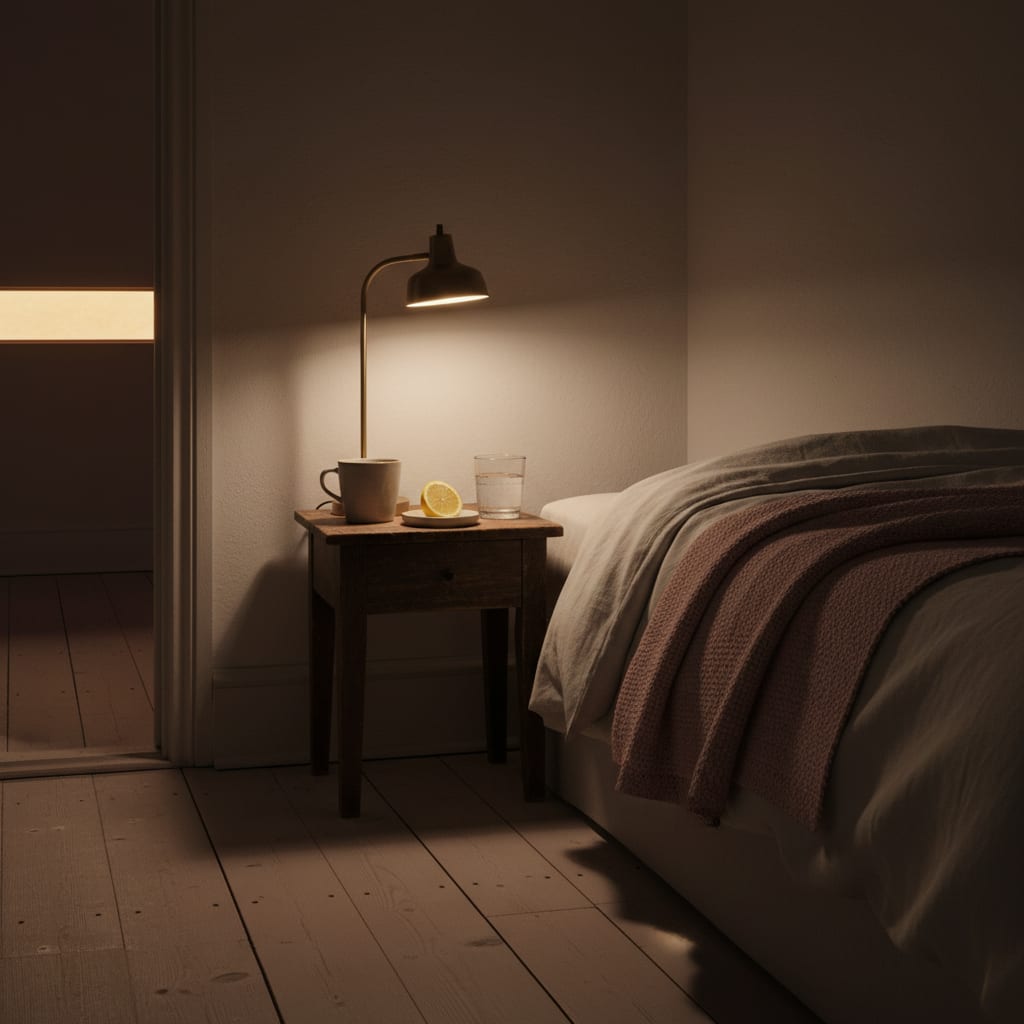
Laryngitis arrives on a Tuesday, and by Wednesday bedtime has lost its soundtrack: the song, the story, the two lines at the door, the calling back up the stairs. The short answer is to swap sound for touch and light, and not to whisper. The NHS’s laryngitis page says it plainly — “do not talk loudly or whisper – both strain your voice” — and the NIDCD lists whispering alongside screaming as an extreme to avoid. Tell your child once, in one concrete sentence, then run the same routine in the same order, silently. It usually passes within a week or two.
Why bedtime is the part of the day that runs on sound
A day at home has redundancy built in. Bedtime does not, because bedtime was never really about information. It is a sequence of sounds in a fixed order, performed by one person — the song, the story voice you do for the wolf, the “night night” at a particular pitch, the answer you call up the stairs when a small person checks you are still there. You built an auditory routine without meaning to, and the instrument is gone for three or four days. Which is why “just point at things” is no help. Pointing does not tell a two-year-old that the day is ending and you are still here. The song did that.
Whispering feels like the compromise and costs you the week
The first instinct is to whisper the song — the reasonable middle: doing the ritual, not shouting, being sensible. Both sources say otherwise. The NHS puts whispering in the same breath as talking loudly, and the NIDCD says “talking too loudly and too softly can both stress your voice.” The arithmetic is simple even where the physiology is arguable: silence costs your voice nothing and whispering costs it something, and what you spend is the only currency that shortens this. “Rest your voice when you are sick,” the NIDCD page says. “Illness puts extra stress on your voice.”
Whispering is also the martyrdom setting: it lets you perform the ritual and be visibly suffering through it, which feels like the only way to be ill and a good mother at once. It is also how three days becomes two weeks. And if you have been running on empty for months rather than days, the throat is not the whole story — parent sleep debt is what makes an ordinary cold land like a felling.
What to put in the gap: touch, light and one repeated signal
The song was doing three jobs — marking the end, setting a tempo, proving you were there — and each can be done without your voice.
Tempo goes to touch. A flat hand on the back at roughly the speed you sang at is the closest analogue there is, and children accept it faster than you expect, because the beat was always the part carrying them down. Keep it regular; the moment it becomes stroking it turns into play.
The ending goes to light. If you have a lamp you can turn down in stages, the stages become the verses: full, half, off, door. If you have only switches: bath light, hall light, room light, in that order, every night.
Proof-of-presence goes to one signal, repeated identically. A double squeeze of the hand, your palm flat on the mattress, the blanket carried down the hall by you and only you. It must be silent and the same every night this week, and not a written note — a note is a thing to read, negotiate and lose. If you would rather borrow vocabulary than invent it, the standard baby signs include a few — finished, sleep, more — that are easy to hold up in a dark room.
And the recording, honestly. If you already have a voice note of yourself singing, play it at the same point in the order and sit still while it plays. Most people do not have one, and today is not the day to make one. Record it when your voice returns, and never need this paragraph again.

Briefing a small child who has no idea what laryngitis is
A toddler has no concept of a temporary illness located in one organ. What they have is: the song did not happen, and nobody said why in a way that stuck.
Say it once at a neutral moment, not in the doorway at 7:29pm, pointing at a part of you they can see: my voice is poorly, so tonight I will pat instead of sing, and it will come back. Then say exactly that, in the same words, every night until it does. Resist improving it: a fresh explanation each evening reads as a fresh problem each evening.
Two things make night one worse. Attempting the song and failing halfway teaches that it is still on the table and tonight’s was a poor effort. And mouthing “night night” silently from the door reads, in a dim room, as a face doing something strange — a toddler will get out of bed to investigate. Expect testing on night one, much less on night two; the protest is a check on whether the rest of the system holds.
The relief, and the guilt that arrives with it
A silent bedtime is, for the mother, considerably nicer. Nobody asks for the wolf voice, and the hour that usually ends with you wanting the volume of the world turned down ends instead in a dim room where you are simply present, and you come downstairs less frayed than usual — on a day you were ill.
That is disconcerting, and it does not mean you dislike the ritual. It means a good part of what tires you at seven o’clock was never the child; it was the output. Being needed silently costs a fraction of what being needed audibly costs, and most weeks nobody hands you the comparison.
Three days is a rehearsal you were never going to schedule
If another adult is in the house, this is the cheapest handover you will ever get. You are still there — on the floor, hand on the back — while somebody else carries the sound, which is a different proposition from being sent downstairs and fails far less often. Give them the words rather than the job: the order of the lights, the three lines of the song, which verse gets skipped. There is a decent stock of lullabies to borrow from if the family repertoire is one song nobody else knows.
If handing it over feels less like relief than loss, that is a separate bind with its own piece here — being the only acceptable person at bedtime is a different problem from being the person and having no voice. And if the two hours before the door opens are what undoes you, the 5-to-7 handover comes next.
How long it lasts, and when it stops being a cold
The NHS page says laryngitis “usually goes away by itself within 1 to 2 weeks,” comes on suddenly and gets worse during the first three days — so if today is day two and you are worse than yesterday, that is the described pattern rather than a deterioration. Its self-care advice is to speak as little as possible, drink plenty of fluids and keep the air moist; it says to see a doctor if symptoms do not improve after two weeks, or if you keep getting laryngitis or voice problems.
Those lines are quoted from two pages loaded and read on 2026-09-19; anything beyond them belongs to a clinician who can look at your throat.
FAQ: doing bedtime without your voice
Should I whisper the song instead of skipping it? No. The NHS lists whispering next to talking loudly as something to avoid, and the NIDCD says both too loud and too soft stress the voice. Rest is the only thing that shortens this.
How do I explain it to a two-year-old? One concrete sentence, said at a calm moment and repeated in identical words each night: my voice is poorly, I will pat instead of sing, it will come back. Do not vary the wording.
What if my child will not settle without the song? Expect one hard night and a much easier second. If another adult is available, have them carry the sound while you stay in the room doing the touch — presence was always the part doing the work.
Three Good Reads
How to Stop Revenge Bedtime Procrastination as a Mom
How to stop revenge bedtime procrastination as a mom — why you scroll until 1am after the kids sleep, and how to get a real evening back instead.
July 17, 2026

Parent Sleep Debt: The Night Shift Swap That Works
Parent sleep debt changes who you are, not just how you feel. Why splitting the night evenly fails, and the shift swap that gives one of you a whole night.
August 3, 2026

Sleep When the Baby Sleeps: Why It Fails and What Helps
Sleep when the baby sleeps is the advice every new parent hears. Why it fails at home with a toddler too, and three things that actually help you bank sleep.
September 27, 2026